Introduction
Error handling is often an afterthought in API development, yet it’s one of the most critical aspects of a good developer experience. For example, a cryptic error message like { "error": "An error occurred" } can lead to hours of frustrating debugging. In this guide, we will build a robust, production-grade error handling framework for a Go application that serves both gRPC and a REST/HTTP proxy based on industry standards like RFC9457 (Problem Details for HTTP APIs) and RFC7807 (obsoleted).
Tenets
Following are tenets of a great API error:
- Structured: machine-readable, not just a string.
- Actionable: explains the developer why the error occurred and, if possible, how to fix it.
- Consistent: all errors, from validation to authentication to server faults, follow the same format.
- Secure: never leaks sensitive internal information like stack traces or database schemas.
Our North Star for HTTP errors will be the Problem Details for HTTP APIs (RFC 9457/7807):
{
  "type": "https://example.com/docs/errors/validation-failed",
  "title": "Validation Failed",
  "status": 400,
  "detail": "The request body failed validation.",
  "instance": "/v1/todos",
  "invalid_params": [
    {
      "field": "title",
      "reason": "must not be empty"
    }
  ]
}
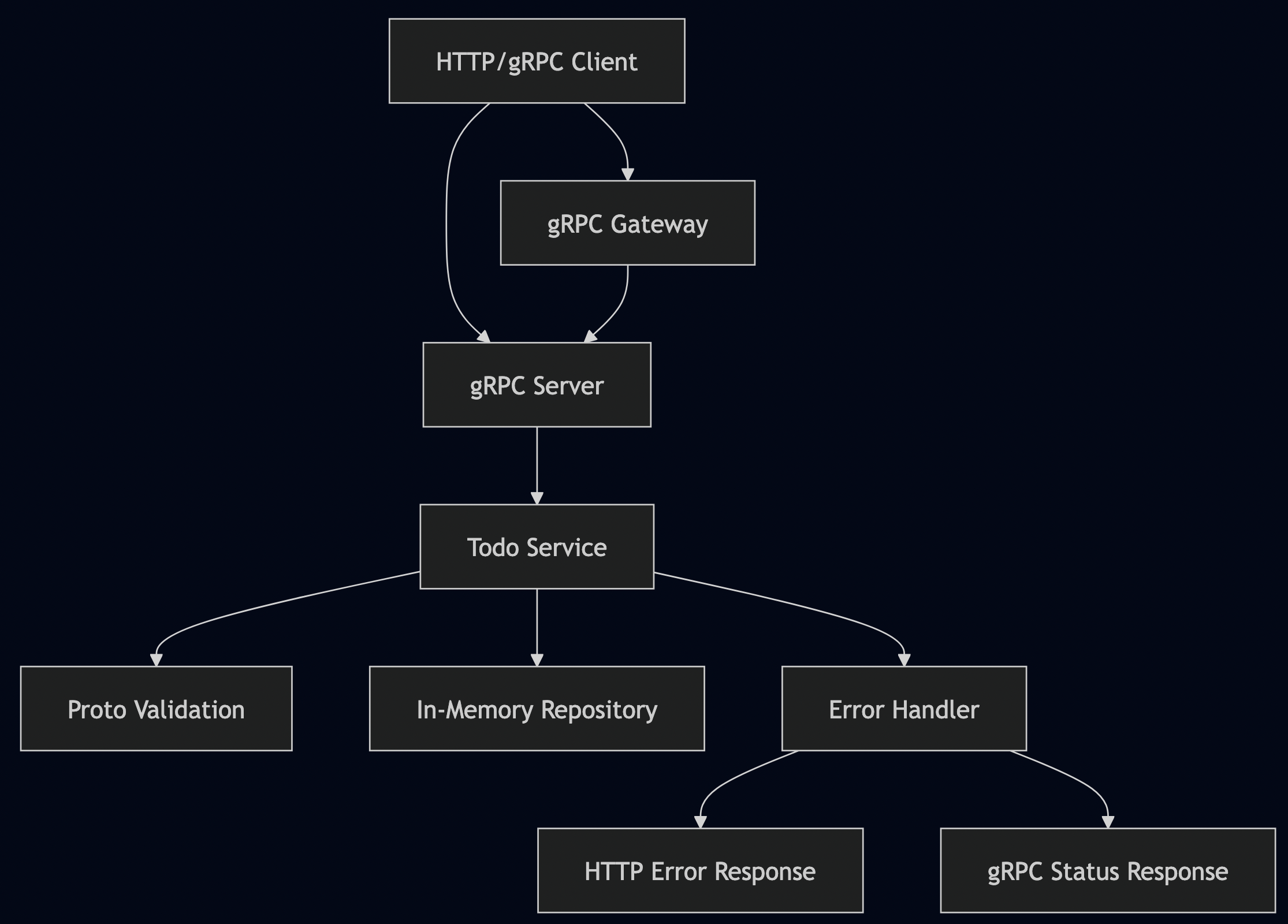
We will adapt this model for gRPC by embedding a similar structure in the gRPC status details, creating a single source of truth for all errors.
API Design
Let’s start by defining our TODO API in Protocol Buffers:
syntax = "proto3";

package todo.v1;

import "google/api/annotations.proto";
import "google/api/field_behavior.proto";
import "google/api/resource.proto";
import "google/protobuf/timestamp.proto";
import "google/protobuf/field_mask.proto";
import "buf/validate/validate.proto";

option go_package = "github.com/bhatti/todo-api-errors/api/proto/todo/v1;todo";

// TodoService provides task management operations
service TodoService {
  // CreateTask creates a new task
  rpc CreateTask(CreateTaskRequest) returns (Task) {
    option (google.api.http) = {
      post: "/v1/tasks"
      body: "*"
    };
  }

  // GetTask retrieves a specific task
  rpc GetTask(GetTaskRequest) returns (Task) {
    option (google.api.http) = {
      get: "/v1/{name=tasks/*}"
    };
  }

  // ListTasks retrieves all tasks
  rpc ListTasks(ListTasksRequest) returns (ListTasksResponse) {
    option (google.api.http) = {
      get: "/v1/tasks"
    };
  }

  // UpdateTask updates an existing task
  rpc UpdateTask(UpdateTaskRequest) returns (Task) {
    option (google.api.http) = {
      patch: "/v1/{task.name=tasks/*}"
      body: "task"
    };
  }

  // DeleteTask removes a task
  rpc DeleteTask(DeleteTaskRequest) returns (DeleteTaskResponse) {
    option (google.api.http) = {
      delete: "/v1/{name=tasks/*}"
    };
  }

  // BatchCreateTasks creates multiple tasks at once
  rpc BatchCreateTasks(BatchCreateTasksRequest) returns (BatchCreateTasksResponse) {
    option (google.api.http) = {
      post: "/v1/tasks:batchCreate"
      body: "*"
    };
  }
}

// Task represents a TODO item
message Task {
  option (google.api.resource) = {
    type: "todo.example.com/Task"
    pattern: "tasks/{task}"
    singular: "task"
    plural: "tasks"
  };

  // Resource name of the task
  string name = 1 [
    (google.api.field_behavior) = IDENTIFIER,
    (google.api.field_behavior) = OUTPUT_ONLY
  ];

  // Task title
  string title = 2 [
    (google.api.field_behavior) = REQUIRED,
    (buf.validate.field).string = {
      min_len: 1
      max_len: 200
    }
  ];

  // Task description
  string description = 3 [
    (google.api.field_behavior) = OPTIONAL,
    (buf.validate.field).string = {
      max_len: 1000
    }
  ];

  // Task status
  Status status = 4 [
    (google.api.field_behavior) = REQUIRED
  ];

  // Task priority
  Priority priority = 5 [
    (google.api.field_behavior) = OPTIONAL
  ];

  // Due date for the task
  google.protobuf.Timestamp due_date = 6 [
    (google.api.field_behavior) = OPTIONAL,
    (buf.validate.field).timestamp = {
      gt_now: true
    }
  ];

  // Task creation time
  google.protobuf.Timestamp create_time = 7 [
    (google.api.field_behavior) = OUTPUT_ONLY
  ];

  // Task last update time
  google.protobuf.Timestamp update_time = 8 [
    (google.api.field_behavior) = OUTPUT_ONLY
  ];

  // User who created the task
  string created_by = 9 [
    (google.api.field_behavior) = OUTPUT_ONLY
  ];

  // Tags associated with the task
  repeated string tags = 10 [
    (buf.validate.field).repeated = {
      max_items: 10
      items: {
        string: {
          pattern: "^[a-z0-9-]+$"
          max_len: 50
        }
      }
    }
  ];
}

// Task status enumeration
enum Status {
  STATUS_UNSPECIFIED = 0;
  STATUS_PENDING = 1;
  STATUS_IN_PROGRESS = 2;
  STATUS_COMPLETED = 3;
  STATUS_CANCELLED = 4;
}

// Task priority enumeration
enum Priority {
  PRIORITY_UNSPECIFIED = 0;
  PRIORITY_LOW = 1;
  PRIORITY_MEDIUM = 2;
  PRIORITY_HIGH = 3;
  PRIORITY_CRITICAL = 4;
}

// CreateTaskRequest message
message CreateTaskRequest {
  // Task to create
  Task task = 1 [
    (google.api.field_behavior) = REQUIRED,
    (buf.validate.field).required = true
  ];
}

// GetTaskRequest message
message GetTaskRequest {
  // Resource name of the task
  string name = 1 [
    (google.api.field_behavior) = REQUIRED,
    (google.api.resource_reference) = {
      type: "todo.example.com/Task"
    },
    (buf.validate.field).string = {
      pattern: "^tasks/[a-zA-Z0-9-]+$"
    }
  ];
}

// ListTasksRequest message
message ListTasksRequest {
  // Maximum number of tasks to return
  int32 page_size = 1 [
    (buf.validate.field).int32 = {
      gte: 0
      lte: 1000
    }
  ];

  // Page token for pagination
  string page_token = 2;

  // Filter expression
  string filter = 3;

  // Order by expression
  string order_by = 4;
}

// ListTasksResponse message
message ListTasksResponse {
  // List of tasks
  repeated Task tasks = 1;

  // Token for next page
  string next_page_token = 2;

  // Total number of tasks
  int32 total_size = 3;
}

// UpdateTaskRequest message
message UpdateTaskRequest {
  // Task to update
  Task task = 1 [
    (google.api.field_behavior) = REQUIRED,
    (buf.validate.field).required = true
  ];

  // Fields to update
  google.protobuf.FieldMask update_mask = 2 [
    (google.api.field_behavior) = REQUIRED,
    (buf.validate.field).required = true
  ];
}

// DeleteTaskRequest message
message DeleteTaskRequest {
  // Resource name of the task
  string name = 1 [
    (google.api.field_behavior) = REQUIRED,
    (google.api.resource_reference) = {
      type: "todo.example.com/Task"
    }
  ];
}

// DeleteTaskResponse message
message DeleteTaskResponse {
  // Confirmation message
  string message = 1;
}

// BatchCreateTasksRequest message
message BatchCreateTasksRequest {
  // Tasks to create
  repeated CreateTaskRequest requests = 1 [
    (google.api.field_behavior) = REQUIRED,
    (buf.validate.field).repeated = {
      min_items: 1
      max_items: 100
    }
  ];
}

// BatchCreateTasksResponse message
message BatchCreateTasksResponse {
  // Created tasks
  repeated Task tasks = 1;
}
syntax = "proto3";
package errors.v1;
import "google/protobuf/timestamp.proto";
import "google/protobuf/any.proto";
option go_package = "github.com/bhatti/todo-api-errors/api/proto/errors/v1;errors";
// ErrorDetail provides a structured, machine-readable error payload.
// It is designed to be embedded in the `details` field of a `google.rpc.Status` message.
message ErrorDetail {
// A unique, application-specific error code.
string code = 1;
// A short, human-readable summary of the problem type.
string title = 2;
// A human-readable explanation specific to this occurrence of the problem.
string detail = 3;
// A list of validation errors, useful for INVALID_ARGUMENT responses.
repeated FieldViolation field_violations = 4;
// Optional trace ID for request correlation
string trace_id = 5;
// Optional timestamp when the error occurred
google.protobuf.Timestamp timestamp = 6;
// Optional instance path where the error occurred
string instance = 7;
// Optional extensions for additional error context
map<string, google.protobuf.Any> extensions = 8;
}
// Describes a single validation failure.
message FieldViolation {
// The path to the field that failed validation, e.g., "title".
string field = 1;
// A developer-facing description of the validation rule that failed.
string description = 2;
// Application-specific error code for this validation failure
string code = 3;
}
// AppErrorCode defines a list of standardized, application-specific error codes.
enum AppErrorCode {
APP_ERROR_CODE_UNSPECIFIED = 0;
// Validation failures
VALIDATION_FAILED = 1;
REQUIRED_FIELD = 2;
TOO_SHORT = 3;
TOO_LONG = 4;
INVALID_FORMAT = 5;
MUST_BE_FUTURE = 6;
INVALID_VALUE = 7;
DUPLICATE_TAG = 8;
INVALID_TAG_FORMAT = 9;
OVERDUE_COMPLETION = 10;
EMPTY_BATCH = 11;
BATCH_TOO_LARGE = 12;
DUPLICATE_TITLE = 13;
// Resource errors
RESOURCE_NOT_FOUND = 1001;
RESOURCE_CONFLICT = 1002;
// Authentication and authorization
AUTHENTICATION_FAILED = 2001;
PERMISSION_DENIED = 2002;
// Rate limiting and service availability
RATE_LIMIT_EXCEEDED = 3001;
SERVICE_UNAVAILABLE = 3002;
// Internal errors
INTERNAL_ERROR = 9001;
}Error Handling Implementation
Now let’s implement our error handling framework:
package errors

import (
	"fmt"

	errorspb "github.com/bhatti/todo-api-errors/api/proto/errors/v1"
	"google.golang.org/genproto/googleapis/rpc/errdetails"
	"google.golang.org/grpc/codes"
	"google.golang.org/grpc/status"
	"google.golang.org/protobuf/types/known/anypb"
	"google.golang.org/protobuf/types/known/timestamppb"
)

// AppError is our custom error type using protobuf definitions.
type AppError struct {
	GRPCCode        codes.Code
	AppCode         errorspb.AppErrorCode
	Title           string
	Detail          string
	FieldViolations []*errorspb.FieldViolation
	TraceID         string
	Instance        string
	Extensions      map[string]*anypb.Any
	CausedBy        error // For internal logging
}

func (e *AppError) Error() string {
	return fmt.Sprintf("gRPC Code: %s, App Code: %s, Title: %s, Detail: %s", e.GRPCCode, e.AppCode, e.Title, e.Detail)
}

// ToGRPCStatus converts our AppError into a gRPC status.Status.
func (e *AppError) ToGRPCStatus() *status.Status {
	st := status.New(e.GRPCCode, e.Title)

	errorDetail := &errorspb.ErrorDetail{
		Code:            e.AppCode.String(),
		Title:           e.Title,
		Detail:          e.Detail,
		FieldViolations: e.FieldViolations,
		TraceId:         e.TraceID,
		Timestamp:       timestamppb.Now(),
		Instance:        e.Instance,
		Extensions:      e.Extensions,
	}

	// For validation errors, we also attach the standard BadRequest detail
	// so that gRPC-Gateway and other standard tools can understand it.
	if e.GRPCCode == codes.InvalidArgument && len(e.FieldViolations) > 0 {
		br := &errdetails.BadRequest{}
		for _, fv := range e.FieldViolations {
			br.FieldViolations = append(br.FieldViolations, &errdetails.BadRequest_FieldViolation{
				Field:       fv.Field,
				Description: fv.Description,
			})
		}
		st, _ = st.WithDetails(br, errorDetail)
		return st
	}

	st, _ = st.WithDetails(errorDetail)
	return st
}

// Helper functions for creating common errors

func NewValidationFailed(violations []*errorspb.FieldViolation, traceID string) *AppError {
	return &AppError{
		GRPCCode:        codes.InvalidArgument,
		AppCode:         errorspb.AppErrorCode_VALIDATION_FAILED,
		Title:           "Validation Failed",
		Detail:          fmt.Sprintf("The request contains %d validation errors", len(violations)),
		FieldViolations: violations,
		TraceID:         traceID,
	}
}

func NewNotFound(resource string, id string, traceID string) *AppError {
	return &AppError{
		GRPCCode: codes.NotFound,
		AppCode:  errorspb.AppErrorCode_RESOURCE_NOT_FOUND,
		Title:    "Resource Not Found",
		Detail:   fmt.Sprintf("%s with ID '%s' was not found.", resource, id),
		TraceID:  traceID,
	}
}

func NewConflict(resource, reason string, traceID string) *AppError {
	return &AppError{
		GRPCCode: codes.AlreadyExists,
		AppCode:  errorspb.AppErrorCode_RESOURCE_CONFLICT,
		Title:    "Resource Conflict",
		Detail:   fmt.Sprintf("Conflict creating %s: %s", resource, reason),
		TraceID:  traceID,
	}
}

func NewInternal(message string, traceID string, causedBy error) *AppError {
	return &AppError{
		GRPCCode: codes.Internal,
		AppCode:  errorspb.AppErrorCode_INTERNAL_ERROR,
		Title:    "Internal Server Error",
		Detail:   message,
		TraceID:  traceID,
		CausedBy: causedBy,
	}
}

func NewPermissionDenied(resource, action string, traceID string) *AppError {
	return &AppError{
		GRPCCode: codes.PermissionDenied,
		AppCode:  errorspb.AppErrorCode_PERMISSION_DENIED,
		Title:    "Permission Denied",
		Detail:   fmt.Sprintf("You don't have permission to %s %s", action, resource),
		TraceID:  traceID,
	}
}

func NewServiceUnavailable(message string, traceID string) *AppError {
	return &AppError{
		GRPCCode: codes.Unavailable,
		AppCode:  errorspb.AppErrorCode_SERVICE_UNAVAILABLE,
		Title:    "Service Unavailable",
		Detail:   message,
		TraceID:  traceID,
	}
}

func NewRequiredField(field, message string, traceID string) *AppError {
	return &AppError{
		GRPCCode: codes.InvalidArgument,
		AppCode:  errorspb.AppErrorCode_VALIDATION_FAILED,
		Title:    "Validation Failed",
		Detail:   "The request contains validation errors",
		FieldViolations: []*errorspb.FieldViolation{
			{
				Field:       field,
				Code:        errorspb.AppErrorCode_REQUIRED_FIELD.String(),
				Description: message,
			},
		},
		TraceID: traceID,
	}
}
Validation Framework
Let’s implement validation that returns all errors at once:
package validation

import (
	"errors"
	"fmt"
	"regexp"
	"strings"

	"buf.build/gen/go/bufbuild/protovalidate/protocolbuffers/go/buf/validate"
	"buf.build/go/protovalidate"
	errorspb "github.com/bhatti/todo-api-errors/api/proto/errors/v1"
	todopb "github.com/bhatti/todo-api-errors/api/proto/todo/v1"
	apperrors "github.com/bhatti/todo-api-errors/internal/errors"
	"google.golang.org/protobuf/proto"
)

var pv protovalidate.Validator

func init() {
	var err error
	pv, err = protovalidate.New()
	if err != nil {
		panic(fmt.Sprintf("failed to initialize protovalidator: %v", err))
	}
}

// ValidateRequest checks a proto message and returns an AppError with all violations.
func ValidateRequest(req proto.Message, traceID string) error {
	if err := pv.Validate(req); err != nil {
		var validationErrs *protovalidate.ValidationError
		if errors.As(err, &validationErrs) {
			var violations []*errorspb.FieldViolation
			for _, violation := range validationErrs.Violations {
				fieldPath := ""
				if violation.Proto.GetField() != nil {
					fieldPath = formatFieldPath(violation.Proto.GetField())
				}

				ruleId := violation.Proto.GetRuleId()
				message := violation.Proto.GetMessage()

				violations = append(violations, &errorspb.FieldViolation{
					Field:       fieldPath,
					Description: message,
					Code:        mapConstraintToCode(ruleId),
				})
			}
			return apperrors.NewValidationFailed(violations, traceID)
		}
		return apperrors.NewInternal("Validation failed", traceID, err)
	}
	return nil
}

// ValidateTask performs additional business logic validation
func ValidateTask(task *todopb.Task, traceID string) error {
	var violations []*errorspb.FieldViolation

	// Proto validation first
	if err := ValidateRequest(task, traceID); err != nil {
		if appErr, ok := err.(*apperrors.AppError); ok {
			violations = append(violations, appErr.FieldViolations...)
		}
	}

	// Additional business rules
	if task.Status == todopb.Status_STATUS_COMPLETED && task.DueDate != nil {
		if task.UpdateTime != nil && task.UpdateTime.AsTime().After(task.DueDate.AsTime()) {
			violations = append(violations, &errorspb.FieldViolation{
				Field:       "due_date",
				Code:        errorspb.AppErrorCode_OVERDUE_COMPLETION.String(),
				Description: "Task was completed after the due date",
			})
		}
	}

	// Validate tags format
	for i, tag := range task.Tags {
		if !isValidTag(tag) {
			violations = append(violations, &errorspb.FieldViolation{
				Field:       fmt.Sprintf("tags[%d]", i),
				Code:        errorspb.AppErrorCode_INVALID_TAG_FORMAT.String(),
				Description: fmt.Sprintf("Tag '%s' must be lowercase letters, numbers, and hyphens only", tag),
			})
		}
	}

	// Check for duplicate tags
	tagMap := make(map[string]bool)
	for i, tag := range task.Tags {
		if tagMap[tag] {
			violations = append(violations, &errorspb.FieldViolation{
				Field:       fmt.Sprintf("tags[%d]", i),
				Code:        errorspb.AppErrorCode_DUPLICATE_TAG.String(),
				Description: fmt.Sprintf("Tag '%s' appears multiple times", tag),
			})
		}
		tagMap[tag] = true
	}

	if len(violations) > 0 {
		return apperrors.NewValidationFailed(violations, traceID)
	}

	return nil
}

// ValidateBatchCreateTasks validates batch operations
func ValidateBatchCreateTasks(req *todopb.BatchCreateTasksRequest, traceID string) error {
	var violations []*errorspb.FieldViolation

	// Check batch size
	if len(req.Requests) == 0 {
		violations = append(violations, &errorspb.FieldViolation{
			Field:       "requests",
			Code:        errorspb.AppErrorCode_EMPTY_BATCH.String(),
			Description: "Batch must contain at least one task",
		})
	}

	if len(req.Requests) > 100 {
		violations = append(violations, &errorspb.FieldViolation{
			Field:       "requests",
			Code:        errorspb.AppErrorCode_BATCH_TOO_LARGE.String(),
			Description: fmt.Sprintf("Batch size %d exceeds maximum of 100", len(req.Requests)),
		})
	}

	// Validate each task
	for i, createReq := range req.Requests {
		if createReq.Task == nil {
			violations = append(violations, &errorspb.FieldViolation{
				Field:       fmt.Sprintf("requests[%d].task", i),
				Code:        errorspb.AppErrorCode_REQUIRED_FIELD.String(),
				Description: "Task is required",
			})
			continue
		}

		// Validate task
		if err := ValidateTask(createReq.Task, traceID); err != nil {
			if appErr, ok := err.(*apperrors.AppError); ok {
				for _, violation := range appErr.FieldViolations {
					violation.Field = fmt.Sprintf("requests[%d].task.%s", i, violation.Field)
					violations = append(violations, violation)
				}
			}
		}
	}

	// Check for duplicate titles
	titleMap := make(map[string][]int)
	for i, createReq := range req.Requests {
		if createReq.Task != nil && createReq.Task.Title != "" {
			titleMap[createReq.Task.Title] = append(titleMap[createReq.Task.Title], i)
		}
	}

	for title, indices := range titleMap {
		if len(indices) > 1 {
			for _, idx := range indices {
				violations = append(violations, &errorspb.FieldViolation{
					Field:       fmt.Sprintf("requests[%d].task.title", idx),
					Code:        errorspb.AppErrorCode_DUPLICATE_TITLE.String(),
					Description: fmt.Sprintf("Title '%s' is used by multiple tasks in the batch", title),
				})
			}
		}
	}

	if len(violations) > 0 {
		return apperrors.NewValidationFailed(violations, traceID)
	}

	return nil
}

// Helper functions
func formatFieldPath(fieldPath *validate.FieldPath) string {
	if fieldPath == nil {
		return ""
	}

	// Build field path from elements
	var parts []string
	for _, element := range fieldPath.GetElements() {
		if element.GetFieldName() != "" {
			parts = append(parts, element.GetFieldName())
		} else if element.GetFieldNumber() != 0 {
			parts = append(parts, fmt.Sprintf("field_%d", element.GetFieldNumber()))
		}
	}

	return strings.Join(parts, ".")
}

func mapConstraintToCode(ruleId string) string {
	switch {
	case strings.Contains(ruleId, "required"):
		return errorspb.AppErrorCode_REQUIRED_FIELD.String()
	case strings.Contains(ruleId, "min_len"):
		return errorspb.AppErrorCode_TOO_SHORT.String()
	case strings.Contains(ruleId, "max_len"):
		return errorspb.AppErrorCode_TOO_LONG.String()
	case strings.Contains(ruleId, "pattern"):
		return errorspb.AppErrorCode_INVALID_FORMAT.String()
	case strings.Contains(ruleId, "gt_now"):
		return errorspb.AppErrorCode_MUST_BE_FUTURE.String()
	case ruleId == "":
		return errorspb.AppErrorCode_VALIDATION_FAILED.String()
	default:
		return errorspb.AppErrorCode_INVALID_VALUE.String()
	}
}

var validTagPattern = regexp.MustCompile(`^[a-z0-9-]+$`)

func isValidTag(tag string) bool {
	return len(tag) <= 50 && validTagPattern.MatchString(tag)
}
Error Handler Middleware
Now let’s create middleware to handle errors consistently:
package middleware

import (
	"context"
	"errors"
	"log"

	apperrors "github.com/bhatti/todo-api-errors/internal/errors"
	"google.golang.org/grpc"
	"google.golang.org/grpc/status"
)

// UnaryErrorInterceptor translates application errors into gRPC statuses.
func UnaryErrorInterceptor(ctx context.Context, req interface{}, info *grpc.UnaryServerInfo, handler grpc.UnaryHandler) (interface{}, error) {
	resp, err := handler(ctx, req)
	if err == nil {
		return resp, nil
	}

	var appErr *apperrors.AppError
	if errors.As(err, &appErr) {
		if appErr.CausedBy != nil {
			log.Printf("ERROR: %s, Original cause: %v", appErr.Title, appErr.CausedBy)
		}
		return nil, appErr.ToGRPCStatus().Err()
	}

	if _, ok := status.FromError(err); ok {
		return nil, err // Already a gRPC status
	}

	log.Printf("UNEXPECTED ERROR: %v", err)
	return nil, apperrors.NewInternal("An unexpected error occurred", "", err).ToGRPCStatus().Err()
}
package middleware
import (
"context"
"encoding/json"
"net/http"
"runtime/debug"
"time"
errorspb "github.com/bhatti/todo-api-errors/api/proto/errors/v1"
apperrors "github.com/bhatti/todo-api-errors/internal/errors"
"github.com/google/uuid"
"github.com/grpc-ecosystem/grpc-gateway/v2/runtime"
"go.opentelemetry.io/otel/trace"
"google.golang.org/grpc/status"
"google.golang.org/protobuf/encoding/protojson"
)
// HTTPErrorHandler handles errors for HTTP endpoints
func HTTPErrorHandler(next http.Handler) http.Handler {
return http.HandlerFunc(func(w http.ResponseWriter, r *http.Request) {
// Add trace ID to context
traceID := r.Header.Get("X-Trace-ID")
if traceID == "" {
traceID = uuid.New().String()
}
ctx := context.WithValue(r.Context(), "traceID", traceID)
r = r.WithContext(ctx)
// Create response wrapper to intercept errors
wrapped := &responseWriter{
ResponseWriter: w,
request: r,
traceID: traceID,
}
// Handle panics
defer func() {
if err := recover(); err != nil {
handlePanic(wrapped, err)
}
}()
// Process request
next.ServeHTTP(wrapped, r)
})
}
// responseWriter wraps http.ResponseWriter to intercept errors
type responseWriter struct {
http.ResponseWriter
request *http.Request
traceID string
statusCode int
written bool
}
func (w *responseWriter) WriteHeader(code int) {
if !w.written {
w.statusCode = code
w.ResponseWriter.WriteHeader(code)
w.written = true
}
}
func (w *responseWriter) Write(b []byte) (int, error) {
if !w.written {
w.WriteHeader(http.StatusOK)
}
return w.ResponseWriter.Write(b)
}
// handlePanic converts panics to proper error responses
func handlePanic(w *responseWriter, recovered interface{}) {
// Log stack trace
debug.PrintStack()
appErr := apperrors.NewInternal("An unexpected error occurred. Please try again later.", w.traceID, nil)
writeErrorResponse(w, appErr)
}
// CustomHTTPError handles gRPC gateway error responses
func CustomHTTPError(ctx context.Context, mux *runtime.ServeMux,
marshaler runtime.Marshaler, w http.ResponseWriter, r *http.Request, err error) {
// Extract trace ID
traceID := r.Header.Get("X-Trace-ID")
if traceID == "" {
if span := trace.SpanFromContext(ctx); span.SpanContext().IsValid() {
traceID = span.SpanContext().TraceID().String()
} else {
traceID = uuid.New().String()
}
}
// Convert gRPC error to HTTP response
st, _ := status.FromError(err)
// Check if we have our custom error detail in status details
for _, detail := range st.Details() {
if errorDetail, ok := detail.(*errorspb.ErrorDetail); ok {
// Update the error detail with current request context
errorDetail.TraceId = traceID
errorDetail.Instance = r.URL.Path
// Convert to JSON and write response
w.Header().Set("Content-Type", "application/problem+json")
w.WriteHeader(runtime.HTTPStatusFromCode(st.Code()))
// Create a simplified JSON response that matches RFC 7807
response := map[string]interface{}{
"type": getTypeForCode(errorDetail.Code),
"title": errorDetail.Title,
"status": runtime.HTTPStatusFromCode(st.Code()),
"detail": errorDetail.Detail,
"instance": errorDetail.Instance,
"traceId": errorDetail.TraceId,
"timestamp": errorDetail.Timestamp,
}
// Add field violations if present
if len(errorDetail.FieldViolations) > 0 {
violations := make([]map[string]interface{}, len(errorDetail.FieldViolations))
for i, fv := range errorDetail.FieldViolations {
violations[i] = map[string]interface{}{
"field": fv.Field,
"code": fv.Code,
"message": fv.Description,
}
}
response["errors"] = violations
}
// Add extensions if present
if len(errorDetail.Extensions) > 0 {
extensions := make(map[string]interface{})
for k, v := range errorDetail.Extensions {
// Convert Any to JSON
if jsonBytes, err := protojson.Marshal(v); err == nil {
var jsonData interface{}
if err := json.Unmarshal(jsonBytes, &jsonData); err == nil {
extensions[k] = jsonData
}
}
}
if len(extensions) > 0 {
response["extensions"] = extensions
}
}
if err := json.NewEncoder(w).Encode(response); err != nil {
http.Error(w, `{"error": "Failed to encode error response"}`, 500)
}
return
}
}
// Fallback: create new error response
fallbackErr := apperrors.NewInternal(st.Message(), traceID, nil)
fallbackErr.GRPCCode = st.Code()
writeAppErrorResponse(w, fallbackErr, r.URL.Path)
}
// Helper functions
func getTypeForCode(code string) string {
switch code {
case errorspb.AppErrorCode_VALIDATION_FAILED.String():
return "https://api.example.com/errors/validation-failed"
case errorspb.AppErrorCode_RESOURCE_NOT_FOUND.String():
return "https://api.example.com/errors/resource-not-found"
case errorspb.AppErrorCode_RESOURCE_CONFLICT.String():
return "https://api.example.com/errors/resource-conflict"
case errorspb.AppErrorCode_PERMISSION_DENIED.String():
return "https://api.example.com/errors/permission-denied"
case errorspb.AppErrorCode_INTERNAL_ERROR.String():
return "https://api.example.com/errors/internal-error"
case errorspb.AppErrorCode_SERVICE_UNAVAILABLE.String():
return "https://api.example.com/errors/service-unavailable"
default:
return "https://api.example.com/errors/unknown"
}
}
func writeErrorResponse(w http.ResponseWriter, err error) {
if appErr, ok := err.(*apperrors.AppError); ok {
writeAppErrorResponse(w, appErr, "")
} else {
http.Error(w, err.Error(), http.StatusInternalServerError)
}
}
func writeAppErrorResponse(w http.ResponseWriter, appErr *apperrors.AppError, instance string) {
statusCode := runtime.HTTPStatusFromCode(appErr.GRPCCode)
response := map[string]interface{}{
"type": getTypeForCode(appErr.AppCode.String()),
"title": appErr.Title,
"status": statusCode,
"detail": appErr.Detail,
"traceId": appErr.TraceID,
"timestamp": time.Now(),
}
if instance != "" {
response["instance"] = instance
}
if len(appErr.FieldViolations) > 0 {
violations := make([]map[string]interface{}, len(appErr.FieldViolations))
for i, fv := range appErr.FieldViolations {
violations[i] = map[string]interface{}{
"field": fv.Field,
"code": fv.Code,
"message": fv.Description,
}
}
response["errors"] = violations
}
w.Header().Set("Content-Type", "application/problem+json")
w.WriteHeader(statusCode)
json.NewEncoder(w).Encode(response)
}Service Implementation
Now let’s implement our TODO service with proper error handling:
package service

import (
	"context"
	"fmt"
	todopb "github.com/bhatti/todo-api-errors/api/proto/todo/v1"
	"github.com/bhatti/todo-api-errors/internal/errors"
	"github.com/bhatti/todo-api-errors/internal/repository"
	"github.com/bhatti/todo-api-errors/internal/validation"
	"github.com/google/uuid"
	"go.opentelemetry.io/otel"
	"go.opentelemetry.io/otel/attribute"
	"go.opentelemetry.io/otel/trace"
	"google.golang.org/protobuf/types/known/fieldmaskpb"
	"google.golang.org/protobuf/types/known/timestamppb"
	"strings"
)

var tracer = otel.Tracer("todo-service")

// TodoService implements the TODO API
type TodoService struct {
	todopb.UnimplementedTodoServiceServer
	repo repository.TodoRepository
}

// NewTodoService creates a new TODO service
func NewTodoService(repo repository.TodoRepository) (*TodoService, error) {
	return &TodoService{
		repo: repo,
	}, nil
}

// CreateTask creates a new task
func (s *TodoService) CreateTask(ctx context.Context, req *todopb.CreateTaskRequest) (*todopb.Task, error) {
	ctx, span := tracer.Start(ctx, "CreateTask")
	defer span.End()

	// Get trace ID for error responses
	traceID := span.SpanContext().TraceID().String()

	// Validate request
	if req.Task == nil {
		return nil, errors.NewRequiredField("task", "Task object is required", traceID)
	}

	// Validate task fields using the new validation package
	if err := validation.ValidateTask(req.Task, traceID); err != nil {
		span.SetAttributes(attribute.String("validation.error", err.Error()))
		return nil, err
	}

	// Check for duplicate title
	existing, err := s.repo.GetTaskByTitle(ctx, req.Task.Title)
	if err != nil && !repository.IsNotFound(err) {
		span.RecordError(err)
		return nil, s.handleRepositoryError(err, traceID)
	}

	if existing != nil {
		return nil, errors.NewConflict("task", "A task with this title already exists", traceID)
	}

	// Generate task ID
	taskID := uuid.New().String()
	task := &todopb.Task{
		Name:        fmt.Sprintf("tasks/%s", taskID),
		Title:       req.Task.Title,
		Description: req.Task.Description,
		Status:      req.Task.Status,
		Priority:    req.Task.Priority,
		DueDate:     req.Task.DueDate,
		Tags:        req.Task.Tags,
		CreateTime:  timestamppb.Now(),
		UpdateTime:  timestamppb.Now(),
		CreatedBy:   s.getUserFromContext(ctx),
	}

	// Set defaults
	if task.Status == todopb.Status_STATUS_UNSPECIFIED {
		task.Status = todopb.Status_STATUS_PENDING
	}
	if task.Priority == todopb.Priority_PRIORITY_UNSPECIFIED {
		task.Priority = todopb.Priority_PRIORITY_MEDIUM
	}

	// Save to repository
	if err := s.repo.CreateTask(ctx, task); err != nil {
		span.RecordError(err)
		return nil, s.handleRepositoryError(err, traceID)
	}

	span.SetAttributes(
		attribute.String("task.id", taskID),
		attribute.String("task.title", task.Title),
	)

	return task, nil
}

// GetTask retrieves a specific task
func (s *TodoService) GetTask(ctx context.Context, req *todopb.GetTaskRequest) (*todopb.Task, error) {
	ctx, span := tracer.Start(ctx, "GetTask")
	defer span.End()

	traceID := span.SpanContext().TraceID().String()

	// Validate request using the new validation package
	if err := validation.ValidateRequest(req, traceID); err != nil {
		return nil, err
	}

	// Extract task ID
	parts := strings.Split(req.Name, "/")
	if len(parts) != 2 || parts[0] != "tasks" {
		return nil, errors.NewRequiredField("name", "Task name must be in format 'tasks/{id}'", traceID)
	}

	taskID := parts[1]
	span.SetAttributes(attribute.String("task.id", taskID))

	// Get from repository
	task, err := s.repo.GetTask(ctx, taskID)
	if err != nil {
		if repository.IsNotFound(err) {
			return nil, errors.NewNotFound("Task", taskID, traceID)
		}
		span.RecordError(err)
		return nil, s.handleRepositoryError(err, traceID)
	}

	// Check permissions
	if !s.canAccessTask(ctx, task) {
		return nil, errors.NewPermissionDenied("task", "read", traceID)
	}

	return task, nil
}

// ListTasks retrieves all tasks
func (s *TodoService) ListTasks(ctx context.Context, req *todopb.ListTasksRequest) (*todopb.ListTasksResponse, error) {
	ctx, span := tracer.Start(ctx, "ListTasks")
	defer span.End()

	traceID := span.SpanContext().TraceID().String()

	// Validate request using the new validation package
	if err := validation.ValidateRequest(req, traceID); err != nil {
		return nil, err
	}

	// Default page size
	pageSize := req.PageSize
	if pageSize == 0 {
		pageSize = 50
	}
	if pageSize > 1000 {
		pageSize = 1000
	}

	span.SetAttributes(
		attribute.Int("page.size", int(pageSize)),
		attribute.String("filter", req.Filter),
	)

	// Parse filter
	filter, err := s.parseFilter(req.Filter)
	if err != nil {
		return nil, errors.NewRequiredField("filter", fmt.Sprintf("Failed to parse filter: %v", err), traceID)
	}

	// Get tasks from repository
	tasks, nextPageToken, err := s.repo.ListTasks(ctx, repository.ListOptions{
		PageSize:  int(pageSize),
		PageToken: req.PageToken,
		Filter:    filter,
		OrderBy:   req.OrderBy,
		UserID:    s.getUserFromContext(ctx),
	})

	if err != nil {
		span.RecordError(err)
		return nil, s.handleRepositoryError(err, traceID)
	}

	// Get total count
	totalSize, err := s.repo.CountTasks(ctx, filter, s.getUserFromContext(ctx))
	if err != nil {
		// Log but don't fail the request
		span.RecordError(err)
		totalSize = -1
	}

	return &todopb.ListTasksResponse{
		Tasks:         tasks,
		NextPageToken: nextPageToken,
		TotalSize:     int32(totalSize),
	}, nil
}

// UpdateTask updates an existing task
func (s *TodoService) UpdateTask(ctx context.Context, req *todopb.UpdateTaskRequest) (*todopb.Task, error) {
	ctx, span := tracer.Start(ctx, "UpdateTask")
	defer span.End()

	traceID := span.SpanContext().TraceID().String()

	// Validate request
	if req.Task == nil {
		return nil, errors.NewRequiredField("task", "Task object is required", traceID)
	}

	if req.UpdateMask == nil || len(req.UpdateMask.Paths) == 0 {
		return nil, errors.NewRequiredField("update_mask", "Update mask must specify which fields to update", traceID)
	}

	// Extract task ID
	parts := strings.Split(req.Task.Name, "/")
	if len(parts) != 2 || parts[0] != "tasks" {
		return nil, errors.NewRequiredField("task.name", "Invalid task name format", traceID)
	}

	taskID := parts[1]
	span.SetAttributes(attribute.String("task.id", taskID))

	// Get existing task
	existing, err := s.repo.GetTask(ctx, taskID)
	if err != nil {
		if repository.IsNotFound(err) {
			return nil, errors.NewNotFound("Task", taskID, traceID)
		}
		return nil, s.handleRepositoryError(err, traceID)
	}

	// Check permissions
	if !s.canModifyTask(ctx, existing) {
		return nil, errors.NewPermissionDenied("task", "update", traceID)
	}

	// Apply updates based on field mask
	updated := s.applyFieldMask(existing, req.Task, req.UpdateMask)
	updated.UpdateTime = timestamppb.Now()

	// Validate updated task using the new validation package
	if err := validation.ValidateTask(updated, traceID); err != nil {
		return nil, err
	}

	// Save to repository
	if err := s.repo.UpdateTask(ctx, updated); err != nil {
		span.RecordError(err)
		return nil, s.handleRepositoryError(err, traceID)
	}

	return updated, nil
}

// DeleteTask removes a task
func (s *TodoService) DeleteTask(ctx context.Context, req *todopb.DeleteTaskRequest) (*todopb.DeleteTaskResponse, error) {
	ctx, span := tracer.Start(ctx, "DeleteTask")
	defer span.End()

	traceID := span.SpanContext().TraceID().String()

	// Validate request using the new validation package
	if err := validation.ValidateRequest(req, traceID); err != nil {
		return nil, err
	}

	// Extract task ID
	parts := strings.Split(req.Name, "/")
	if len(parts) != 2 || parts[0] != "tasks" {
		return nil, errors.NewRequiredField("name", "Invalid task name format", traceID)
	}

	taskID := parts[1]
	span.SetAttributes(attribute.String("task.id", taskID))

	// Get existing task to check permissions
	existing, err := s.repo.GetTask(ctx, taskID)
	if err != nil {
		if repository.IsNotFound(err) {
			return nil, errors.NewNotFound("Task", taskID, traceID)
		}
		return nil, s.handleRepositoryError(err, traceID)
	}

	// Check permissions
	if !s.canModifyTask(ctx, existing) {
		return nil, errors.NewPermissionDenied("task", "delete", traceID)
	}

	// Delete from repository
	if err := s.repo.DeleteTask(ctx, taskID); err != nil {
		span.RecordError(err)
		return nil, s.handleRepositoryError(err, traceID)
	}

	return &todopb.DeleteTaskResponse{
		Message: fmt.Sprintf("Task %s deleted successfully", req.Name),
	}, nil
}

// BatchCreateTasks creates multiple tasks at once
func (s *TodoService) BatchCreateTasks(ctx context.Context, req *todopb.BatchCreateTasksRequest) (*todopb.BatchCreateTasksResponse, error) {
	ctx, span := tracer.Start(ctx, "BatchCreateTasks")
	defer span.End()

	traceID := span.SpanContext().TraceID().String()

	// Validate batch request using the new validation package
	if err := validation.ValidateBatchCreateTasks(req, traceID); err != nil {
		span.SetAttributes(attribute.String("validation.error", err.Error()))
		return nil, err
	}

	// Process each task
	var created []*todopb.Task
	var batchErrors []string

	for i, createReq := range req.Requests {
		task, err := s.CreateTask(ctx, createReq)
		if err != nil {
			// Collect errors for batch response
			batchErrors = append(batchErrors, fmt.Sprintf("Task %d: %s", i, err.Error()))
			continue
		}
		created = append(created, task)
	}

	// If all tasks failed, return error
	if len(created) == 0 && len(batchErrors) > 0 {
		return nil, errors.NewInternal("All batch operations failed", traceID, nil)
	}

	// Return partial success
	response := &todopb.BatchCreateTasksResponse{
		Tasks: created,
	}

	// Add partial errors to response metadata if any
	if len(batchErrors) > 0 {
		span.SetAttributes(
			attribute.Int("batch.total", len(req.Requests)),
			attribute.Int("batch.success", len(created)),
			attribute.Int("batch.failed", len(batchErrors)),
		)
	}

	return response, nil
}

// Helper methods

func (s *TodoService) handleRepositoryError(err error, traceID string) error {
	if repository.IsConnectionError(err) {
		return errors.NewServiceUnavailable("Unable to connect to the database. Please try again later.", traceID)
	}

	// Log internal error details
	span := trace.SpanFromContext(context.Background())
	if span != nil {
		span.RecordError(err)
	}

	return errors.NewInternal("An unexpected error occurred while processing your request", traceID, err)
}

func (s *TodoService) getUserFromContext(ctx context.Context) string {
	// In a real implementation, this would extract user info from auth context
	if user, ok := ctx.Value("user").(string); ok {
		return user
	}
	return "anonymous"
}

func (s *TodoService) canAccessTask(ctx context.Context, task *todopb.Task) bool {
	// In a real implementation, check if user can access this task
	user := s.getUserFromContext(ctx)
	return user == task.CreatedBy || user == "admin"
}

func (s *TodoService) canModifyTask(ctx context.Context, task *todopb.Task) bool {
	// In a real implementation, check if user can modify this task
	user := s.getUserFromContext(ctx)
	return user == task.CreatedBy || user == "admin"
}

func (s *TodoService) parseFilter(filter string) (map[string]interface{}, error) {
	// Simple filter parser - in production, use a proper parser
	parsed := make(map[string]interface{})

	if filter == "" {
		return parsed, nil
	}

	// Example: "status=COMPLETED AND priority=HIGH"
	parts := strings.Split(filter, " AND ")
	for _, part := range parts {
		kv := strings.Split(strings.TrimSpace(part), "=")
		if len(kv) != 2 {
			return nil, fmt.Errorf("invalid filter expression: %s", part)
		}

		key := strings.TrimSpace(kv[0])
		value := strings.Trim(strings.TrimSpace(kv[1]), "'\"")

		// Validate filter keys
		switch key {
		case "status", "priority", "created_by":
			parsed[key] = value
		default:
			return nil, fmt.Errorf("unknown filter field: %s", key)
		}
	}

	return parsed, nil
}

func (s *TodoService) applyFieldMask(existing, update *todopb.Task, mask *fieldmaskpb.FieldMask) *todopb.Task {
	result := *existing

	for _, path := range mask.Paths {
		switch path {
		case "title":
			result.Title = update.Title
		case "description":
			result.Description = update.Description
		case "status":
			result.Status = update.Status
		case "priority":
			result.Priority = update.Priority
		case "due_date":
			result.DueDate = update.DueDate
		case "tags":
			result.Tags = update.Tags
		}
	}
	return &result
}
Server Implementation
Now let’s put it all together in our server:
package main

import (
	"context"
	"fmt"
	"log"
	"net"
	"net/http"
	"os"
	"os/signal"
	"syscall"
	"time"

	todopb "github.com/bhatti/todo-api-errors/api/proto/todo/v1"
	"github.com/bhatti/todo-api-errors/internal/middleware"
	"github.com/bhatti/todo-api-errors/internal/monitoring"
	"github.com/bhatti/todo-api-errors/internal/repository"
	"github.com/bhatti/todo-api-errors/internal/service"

	"github.com/grpc-ecosystem/grpc-gateway/v2/runtime"
	"github.com/prometheus/client_golang/prometheus/promhttp"
	"google.golang.org/grpc"
	"google.golang.org/grpc/codes"
	"google.golang.org/grpc/credentials/insecure"
	"google.golang.org/grpc/reflection"
	"google.golang.org/grpc/status"
	"google.golang.org/protobuf/encoding/protojson"
)

func main() {
	// Initialize monitoring
	if err := monitoring.InitOpenTelemetryMetrics(); err != nil {
		log.Printf("Failed to initialize OpenTelemetry metrics: %v", err)
		// Continue without OpenTelemetry - Prometheus will still work
	}

	// Initialize repository
	repo := repository.NewInMemoryRepository()

	// Initialize service
	todoService, err := service.NewTodoService(repo)
	if err != nil {
		log.Fatalf("Failed to create service: %v", err)
	}

	// Start gRPC server
	grpcPort := ":50051"
	go func() {
		if err := startGRPCServer(grpcPort, todoService); err != nil {
			log.Fatalf("Failed to start gRPC server: %v", err)
		}
	}()

	// Start HTTP gateway
	httpPort := ":8080"
	go func() {
		if err := startHTTPGateway(httpPort, grpcPort); err != nil {
			log.Fatalf("Failed to start HTTP gateway: %v", err)
		}
	}()

	// Start metrics server
	go func() {
		http.Handle("/metrics", promhttp.Handler())
		if err := http.ListenAndServe(":9090", nil); err != nil {
			log.Printf("Failed to start metrics server: %v", err)
		}
	}()

	log.Printf("TODO API server started")
	log.Printf("gRPC server listening on %s", grpcPort)
	log.Printf("HTTP gateway listening on %s", httpPort)
	log.Printf("Metrics available at :9090/metrics")

	// Wait for interrupt signal
	sigCh := make(chan os.Signal, 1)
	signal.Notify(sigCh, syscall.SIGINT, syscall.SIGTERM)
	<-sigCh

	log.Println("Shutting down...")
}

func startGRPCServer(port string, todoService todopb.TodoServiceServer) error {
	lis, err := net.Listen("tcp", port)
	if err != nil {
		return fmt.Errorf("failed to listen: %w", err)
	}

	// Create gRPC server with interceptors - now using the new UnaryErrorInterceptor
	opts := []grpc.ServerOption{
		grpc.ChainUnaryInterceptor(
			middleware.UnaryErrorInterceptor, // Using new protobuf-based error interceptor
			loggingInterceptor(),
			recoveryInterceptor(),
		),
	}

	server := grpc.NewServer(opts...)

	// Register service
	todopb.RegisterTodoServiceServer(server, todoService)

	// Register reflection for debugging
	reflection.Register(server)

	return server.Serve(lis)
}

func startHTTPGateway(httpPort, grpcPort string) error {
	ctx := context.Background()

	// Create gRPC connection
	conn, err := grpc.DialContext(
		ctx,
		"localhost"+grpcPort,
		grpc.WithTransportCredentials(insecure.NewCredentials()),
	)
	if err != nil {
		return fmt.Errorf("failed to dial gRPC server: %w", err)
	}

	// Create gateway mux with custom error handler
	mux := runtime.NewServeMux(
		runtime.WithErrorHandler(middleware.CustomHTTPError), // Using new protobuf-based error handler
		runtime.WithMarshalerOption(runtime.MIMEWildcard, &runtime.JSONPb{
			MarshalOptions: protojson.MarshalOptions{
				UseProtoNames:   true,
				EmitUnpopulated: false,
			},
			UnmarshalOptions: protojson.UnmarshalOptions{
				DiscardUnknown: true,
			},
		}),
	)

	// Register service handler
	if err := todopb.RegisterTodoServiceHandler(ctx, mux, conn); err != nil {
		return fmt.Errorf("failed to register service handler: %w", err)
	}

	// Create HTTP server with middleware
	handler := middleware.HTTPErrorHandler( // Using new protobuf-based HTTP error handler
		corsMiddleware(
			authMiddleware(
				loggingHTTPMiddleware(mux),
			),
		),
	)

	server := &http.Server{
		Addr:         httpPort,
		Handler:      handler,
		ReadTimeout:  10 * time.Second,
		WriteTimeout: 10 * time.Second,
		IdleTimeout:  120 * time.Second,
	}

	return server.ListenAndServe()
}

// Middleware implementations

func loggingInterceptor() grpc.UnaryServerInterceptor {
	return func(ctx context.Context, req interface{}, info *grpc.UnaryServerInfo, handler grpc.UnaryHandler) (interface{}, error) {
		start := time.Now()

		// Call handler
		resp, err := handler(ctx, req)

		// Log request
		duration := time.Since(start)
		statusCode := "OK"
		if err != nil {
			statusCode = status.Code(err).String()
		}

		log.Printf("gRPC: %s %s %s %v", info.FullMethod, statusCode, duration, err)

		return resp, err
	}
}

func recoveryInterceptor() grpc.UnaryServerInterceptor {
	return func(ctx context.Context, req interface{}, info *grpc.UnaryServerInfo, handler grpc.UnaryHandler) (resp interface{}, err error) {
		defer func() {
			if r := recover(); r != nil {
				log.Printf("Recovered from panic: %v", r)
				monitoring.RecordPanicRecovery(ctx)
				err = status.Error(codes.Internal, "Internal server error")
			}
		}()

		return handler(ctx, req)
	}
}

func loggingHTTPMiddleware(next http.Handler) http.Handler {
	return http.HandlerFunc(func(w http.ResponseWriter, r *http.Request) {
		start := time.Now()

		// Wrap response writer to capture status
		wrapped := &statusResponseWriter{ResponseWriter: w, statusCode: http.StatusOK}

		// Process request
		next.ServeHTTP(wrapped, r)

		// Log request
		duration := time.Since(start)
		log.Printf("HTTP: %s %s %d %v", r.Method, r.URL.Path, wrapped.statusCode, duration)
	})
}

func corsMiddleware(next http.Handler) http.Handler {
	return http.HandlerFunc(func(w http.ResponseWriter, r *http.Request) {
		w.Header().Set("Access-Control-Allow-Origin", "*")
		w.Header().Set("Access-Control-Allow-Methods", "GET, POST, PUT, DELETE, OPTIONS, PATCH")
		w.Header().Set("Access-Control-Allow-Headers", "Content-Type, Authorization, X-Trace-ID")

		if r.Method == "OPTIONS" {
			w.WriteHeader(http.StatusOK)
			return
		}

		next.ServeHTTP(w, r)
	})
}

func authMiddleware(next http.Handler) http.Handler {
	return http.HandlerFunc(func(w http.ResponseWriter, r *http.Request) {
		// Simple auth for demo - in production use proper authentication
		authHeader := r.Header.Get("Authorization")
		if authHeader == "" {
			authHeader = "Bearer anonymous"
		}

		// Extract user from token
		user := "anonymous"
		if len(authHeader) > 7 && authHeader[:7] == "Bearer " {
			user = authHeader[7:]
		}

		// Add user to context
		ctx := context.WithValue(r.Context(), "user", user)
		next.ServeHTTP(w, r.WithContext(ctx))
	})
}

type statusResponseWriter struct {
	http.ResponseWriter
	statusCode int
}

func (w *statusResponseWriter) WriteHeader(code int) {
	w.statusCode = code
	w.ResponseWriter.WriteHeader(code)
}
Example API Usage
Let’s see our error handling in action with some example requests:
Example 1: Validation Error with Multiple Issues
Request with multiple validation errors
curl -X POST http://localhost:8080/v1/tasks \
-H "Content-Type: application/json" \
-d '{
"task": {
"title": "",
"description": "This description is wayyyyyyyyyyyyyyyyyyyyyyyyyyyyyyyyyyyyyyyyyyyyyyyyyyyyyyyyyyyyyyyyyyyyyyyyyyyyyyyyyyyyyyyyyyyyy too long…",
"status": "INVALID_STATUS",
"tags": ["INVALID TAG", "tag-1", "tag-1"]
}
}'
Response
< HTTP/1.1 422 Unprocessable Entity
< Content-Type: application/problem+json
{
  "detail": "The request contains 5 validation errors",
  "errors": [
    {
      "code": "TOO_SHORT",
      "field": "title",
      "message": "value length must be at least 1 characters"
    },
    {
      "code": "TOO_LONG",
      "field": "description",
      "message": "value length must be at most 100 characters"
    },
    {
      "code": "INVALID_FORMAT",
      "field": "tags",
      "message": "value does not match regex pattern `^[a-z0-9-]+$`"
    },
    {
      "code": "INVALID_TAG_FORMAT",
      "field": "tags[0]",
      "message": "Tag 'INVALID TAG' must be lowercase letters, numbers, and hyphens only"
    },
    {
      "code": "DUPLICATE_TAG",
      "field": "tags[2]",
      "message": "Tag 'tag-1' appears multiple times"
    }
  ],
  "instance": "/v1/tasks",
  "status": 400,
  "timestamp": {
    "seconds": 1755288524,
    "nanos": 484865000
  },
  "title": "Validation Failed",
  "traceId": "eb4bfb3f-9397-4547-8618-ce9952a16067",
  "type": "https://api.example.com/errors/validation-failed"
}
Example 2: Not Found Error
Request for non-existent task
curl http://localhost:8080/v1/tasks/non-existent-id
Response
< HTTP/1.1 404 Not Found
< Content-Type: application/problem+json
{
  "detail": "Task with ID 'non-existent-id' was not found.",
  "instance": "/v1/tasks/non-existent-id",
  "status": 404,
  "timestamp": {
    "seconds": 1755288565,
    "nanos": 904607000
  },
  "title": "Resource Not Found",
  "traceId": "6ce00cd8-d0b7-47f1-b6f6-9fc1375c26a4",
  "type": "https://api.example.com/errors/resource-not-found"
}
Example 3: Conflict Error
curl -X POST http://localhost:8080/v1/tasks \
-H "Content-Type: application/json" \
-d '{
"task": {
"title": "Existing Task Title"
}
}'

curl -X POST http://localhost:8080/v1/tasks \
-H "Content-Type: application/json" \
-d '{
"task": {
"title": "Existing Task Title"
}
}'
Response
< HTTP/1.1 409 Conflict
< Content-Type: application/problem+json
{
  "detail": "Conflict creating task: A task with this title already exists",
  "instance": "/v1/tasks",
  "status": 409,
  "timestamp": {
    "seconds": 1755288593,
    "nanos": 594458000
  },
  "title": "Resource Conflict",
  "traceId": "ed2e78d2-591d-492a-8d71-6b6843ce86f7",
  "type": "https://api.example.com/errors/resource-conflict"
}
Example 4: Service Unavailable (Transient Error)
When database is down
curl http://localhost:8080/v1/tasks
Response
HTTP/1.1 503 Service Unavailable
Content-Type: application/problem+json
Retry-After: 30
{
  "type": "https://api.example.com/errors/service-unavailable",
  "title": "Service Unavailable",
  "status": 503,
  "detail": "Database connection pool exhausted. Please try again later.",
  "instance": "/v1/tasks",
  "traceId": "db-pool-001",
  "timestamp": "2025-08-15T10:30:00Z",
  "extensions": {
    "retryable": true,
    "retryAfter": "2025-08-15T10:30:30Z",
    "maxRetries": 3,
    "backoffType": "exponential",
    "backoffMs": 1000,
    "errorCategory": "database"
  }
}
Best Practices Summary
Our implementation demonstrates several key best practices:
1. Consistent Error Format
All errors follow RFC 9457 (Problem Details) format, providing:
- Machine-readable type URIs
- Human-readable titles and details
- HTTP status codes
- Request tracing
- Extensible metadata
2. Comprehensive Validation
- All validation errors are returned at once, not one by one
- Clear field paths for nested objects
- Descriptive error codes and messages
- Support for batch operations with partial success
3. Security-Conscious Design
- No sensitive information in error messages
- Internal errors are logged but not exposed
- Generic messages for authentication failures
- Request IDs for support without exposing internals
4. Developer Experience
- Clear, actionable error messages
- Helpful suggestions for fixing issues
- Consistent error codes across protocols
- Rich metadata for debugging
5. Protocol Compatibility
- Seamless translation between gRPC and HTTP
- Proper status code mapping
- Preservation of error details across protocols
6. Observability
- Structured logging with trace IDs
- Prometheus metrics for monitoring
- OpenTelemetry integration
- Error categorization for analysis
Conclusion
This comprehensive guide demonstrates how to build robust error handling for modern APIs. By treating errors as a first-class feature of our API, we’ve achieved several key benefits:
- Consistency: All errors, regardless of their source, are presented to clients in a predictable format.
- Clarity: Developers consuming our API get clear, actionable feedback, helping them debug and integrate faster.
- Developer Ergonomics: Our internal service code is cleaner, as handlers focus on business logic while the middleware handles the boilerplate of error conversion.
- Security: We have a clear separation between internal error details (for logging) and public error responses, preventing leaks.
Additional Resources
- RFC 9457: Problem Details for HTTP APIs
- Google API Improvement Proposals (AIPs)
- gRPC Error Handling Best Practices
- OpenTelemetry Error Tracking
You can find the full source code for this example in this GitHub repository.