Introduction
I started writing network code in the early 1990s on IBM mainframes, armed with nothing but Assembly and COBOL. Today, I build distributed AI agents using gRPC, RAG pipelines, and serverless functions. Between these worlds lie decades of technological evolution and an uncomfortable realization: we keep relearning the same lessons. Over the years, I’ve seen simple ideas triumph over complex ones. The technology keeps changing, but the problems stay the same. Network latency hasn’t gotten faster relative to CPU speed. Distributed systems are still hard. Complexity still kills projects. And every new generation has to learn that abstractions leak. I’ll show you the technologies I’ve used, the mistakes I’ve made, and most importantly, what the past teaches us about building better systems in the future.

The Mainframe Era
CICS and 3270 Terminals
I started my career on IBM mainframes running CICS, which was used to build online applications accessed through 3270 “green screen” terminals. It used LU6.2 (Logical Unit 6.2) protocol, part of IBM’s Systems Network Architecture (SNA) to provide peer-to-peer communication. Here’s what a typical CICS application looked like in COBOL:
IDENTIFICATION DIVISION.
PROGRAM-ID. CUSTOMER-INQUIRY.

DATA DIVISION.
WORKING-STORAGE SECTION.
01  CUSTOMER-REC.
    05  CUST-ID        PIC 9(8).
    05  CUST-NAME      PIC X(30).
    05  CUST-BALANCE   PIC 9(7)V99.

LINKAGE SECTION.
01  DFHCOMMAREA.
    05  COMM-CUST-ID   PIC 9(8).

PROCEDURE DIVISION.
    EXEC CICS
        RECEIVE MAP('CUSTMAP')
        MAPSET('CUSTSET')
        INTO(CUSTOMER-REC)
    END-EXEC.

    EXEC CICS
        READ FILE('CUSTFILE')
        INTO(CUSTOMER-REC)
        RIDFLD(COMM-CUST-ID)
    END-EXEC.

    EXEC CICS
        SEND MAP('RESULTMAP')
        MAPSET('CUSTSET')
        FROM(CUSTOMER-REC)
    END-EXEC.

    EXEC CICS RETURN END-EXEC.
The CICS environment handled all the complexity—transaction management, terminal I/O, file access, and inter-system communication. For the user interface, I used Basic Mapping Support (BMS), which was notoriously finicky. You had to define screen layouts in a rigid format specifying exactly where each field appeared on the 24×80 character grid:
CUSTMAP  DFHMSD TYPE=&SYSPARM,                                    X
               MODE=INOUT,                                        X
               LANG=COBOL,                                        X
               CTRL=FREEKB
         DFHMDI SIZE=(24,80)
CUSTID   DFHMDF POS=(05,20),                                      X
               LENGTH=08,                                         X
               ATTRB=(UNPROT,NUM),                                X
               INITIAL='________'
CUSTNAME DFHMDF POS=(07,20),                                      X
               LENGTH=30,                                         X
               ATTRB=PROT
This was so painful that I wrote my own tool to convert simple text-based UI templates into BMS format. Looking back, this was my first foray into creating developer tools. Key lesson I learned from the mainframe era was that developer experience mattered. Cumbersome tools slow down development and introduce errors.
Moving to UNIX
Berkeley Sockets
After working on mainframes for a couple of years, I saw the mainframes were already in decline and I then transitioned to C and UNIX systems, which I studied previously in my college. I learned about Berkeley Sockets, which was a lot more powerful and you had complete control over the network. Here’s a simple TCP server in C using Berkeley Sockets:
#include <sys/types.h>
#include <sys/socket.h>
#include <netinet/in.h>
#include <arpa/inet.h>
#include <unistd.h>
#include <stdio.h>
#include <stdlib.h>
#include <string.h>

#define PORT 8080
#define BUFFER_SIZE 1024

int main() {
    int server_fd, client_fd;
    struct sockaddr_in server_addr, client_addr;
    socklen_t client_len = sizeof(client_addr);
    char buffer[BUFFER_SIZE];

    // Create socket
    server_fd = socket(AF_INET, SOCK_STREAM, 0);
    if (server_fd < 0) {
        perror("socket failed");
        exit(EXIT_FAILURE);
    }

    // Set socket options to reuse address
    int opt = 1;
    if (setsockopt(server_fd, SOL_SOCKET, SO_REUSEADDR,
                   &opt, sizeof(opt)) < 0) {
        perror("setsockopt failed");
        exit(EXIT_FAILURE);
    }

    // Bind to address
    memset(&server_addr, 0, sizeof(server_addr));
    server_addr.sin_family = AF_INET;
    server_addr.sin_addr.s_addr = INADDR_ANY;
    server_addr.sin_port = htons(PORT);

    if (bind(server_fd, (struct sockaddr *)&server_addr,
             sizeof(server_addr)) < 0) {
        perror("bind failed");
        exit(EXIT_FAILURE);
    }

    // Listen for connections
    if (listen(server_fd, 10) < 0) {
        perror("listen failed");
        exit(EXIT_FAILURE);
    }

    printf("Server listening on port %d\n", PORT);

    while (1) {
        // Accept connection
        client_fd = accept(server_fd,
                          (struct sockaddr *)&client_addr,
                          &client_len);
        if (client_fd < 0) {
            perror("accept failed");
            continue;
        }

        // Read request
        ssize_t bytes_read = recv(client_fd, buffer,
                                  BUFFER_SIZE - 1, 0);
        if (bytes_read > 0) {
            buffer[bytes_read] = '\0';
            printf("Received: %s\n", buffer);

            // Send response
            const char *response = "Message received\n";
            send(client_fd, response, strlen(response), 0);
        }

        close(client_fd);
    }

    close(server_fd);
    return 0;
}
As you can see, you had to track a lot of housekeeping like socket creation, binding, listening, accepting, reading, writing, and meticulous error handling at every step. Memory management was entirely manual—forget to close() a file descriptor and you’d leak resources. If you make a mistake with recv() buffer sizes and you’d overflow memory. I also experimented with Fast Sockets from UC Berkeley, which used kernel bypass techniques for lower latency and offered better performance.
Key lesson I learned was that low-level control comes at a steep cost. The cognitive load of managing these details makes it nearly impossible to focus on business logic.
Sun RPC and XDR
When working for a physics lab with a large computing facilities consists of Sun workstations, Solaris, and SPARC processors, I discovered Sun RPC (Remote Procedure Call) with XDR (External Data Representation). XDR solved a critical problem: how do you exchange data between machines with different architectures? A SPARC processor uses big-endian byte ordering, while x86 uses little-endian. XDR provided a canonical, architecture-neutral format for representing data. Here’s an XDR definition file (types.x):
/* Define a structure for customer data */
struct customer {
    int customer_id;
    string name<30>;
    float balance;
};

/* Define the RPC program */
program CUSTOMER_PROG {
    version CUSTOMER_VERS {
        int ADD_CUSTOMER(customer) = 1;
        customer GET_CUSTOMER(int) = 2;
    } = 1;
} = 0x20000001;
You’d run rpcgen on this file:
$ rpcgen types.x
This generated the client stub, server stub, and XDR serialization code automatically. Here’s what the server implementation looked like:
#include "types.h"

int *add_customer_1_svc(customer *cust, struct svc_req *rqstp) {
    static int result;

    // Add customer to database
    printf("Adding customer: %s (ID: %d)\n",
           cust->name, cust->customer_id);

    result = 1;  // Success
    return &result;
}

customer *get_customer_1_svc(int *cust_id, struct svc_req *rqstp) {
    static customer result;

    // Fetch from database
    result.customer_id = *cust_id;
    result.name = strdup("John Doe");
    result.balance = 1000.50;

    return &result;
}
And the client:
#include "types.h"

int main(int argc, char *argv[]) {
    CLIENT *clnt;
    customer cust;
    int *result;

    clnt = clnt_create("localhost", CUSTOMER_PROG,
                       CUSTOMER_VERS, "tcp");
    if (clnt == NULL) {
        clnt_pcreateerror("localhost");
        exit(1);
    }

    // Call remote procedure
    cust.customer_id = 123;
    cust.name = "Alice Smith";
    cust.balance = 5000.00;

    result = add_customer_1(&cust, clnt);
    if (result == NULL) {
        clnt_perror(clnt, "call failed");
    }

    clnt_destroy(clnt);
    return 0;
}
This was my first introduction to Interface Definition Languages (IDL) and I found that defining the contract once and generating code automatically reduces errors. This pattern would reappear in CORBA, Protocol Buffers, and gRPC.
Parallel Computing
During my graduate and post-graduate studies in mid 1990s while working full time, I researched into the parallel and distributed computing. I worked with MPI (Message Passing Interface) and IBM’s MPL on SP1/SP2 systems. MPI provided collective operations like broadcast, scatter, gather, and reduce (predecessor to Hadoop like map/reduce). Here’s a simple MPI example that computes the sum of an array in parallel:
#include <mpi.h>
#include <stdio.h>
#include <stdlib.h>

#define ARRAY_SIZE 1000

int main(int argc, char** argv) {
    int rank, size;
    int data[ARRAY_SIZE];
    int local_sum = 0, global_sum = 0;
    int chunk_size, start, end;

    MPI_Init(&argc, &argv);
    MPI_Comm_rank(MPI_COMM_WORLD, &rank);
    MPI_Comm_size(MPI_COMM_WORLD, &size);

    // Initialize data on root
    if (rank == 0) {
        for (int i = 0; i < ARRAY_SIZE; i++) {
            data[i] = i + 1;
        }
    }

    // Broadcast data to all processes
    MPI_Bcast(data, ARRAY_SIZE, MPI_INT, 0, MPI_COMM_WORLD);

    // Each process computes sum of its chunk
    chunk_size = ARRAY_SIZE / size;
    start = rank * chunk_size;
    end = (rank == size - 1) ? ARRAY_SIZE : start + chunk_size;

    for (int i = start; i < end; i++) {
        local_sum += data[i];
    }

    // Reduce all local sums to global sum
    MPI_Reduce(&local_sum, &global_sum, 1, MPI_INT,
               MPI_SUM, 0, MPI_COMM_WORLD);

    if (rank == 0) {
        printf("Global sum: %d\n", global_sum);
    }

    MPI_Finalize();
    return 0;
}
For my post-graduate project, I built JavaNOW (Java on Networks of Workstations), which was inspired by Linda’s tuple spaces and MPI’s collective operations, but implemented in pure Java for portability. The key innovation was our Actor-inspired model. Instead of heavyweight processes communicating through message passing, I used lightweight Java threads with an Entity Space (distributed associative memory) where “actors” could put and get entities asynchronously. Here’s a simple example:
public class SumTask extends ActiveEntity {
    public Object execute(Object arg, JavaNOWAPI api) {
        Integer myId = (Integer) arg;
        EntitySpace workspace = new EntitySpace("RESULTS");

        // Compute partial sum
        int partialSum = 0;
        for (int i = myId * 100; i < (myId + 1) * 100; i++) {
            partialSum += i;
        }

        // Store result in EntitySpace
        return new Integer(partialSum);
    }
}

// Main application
public class ParallelSum extends JavaNOWApplication {
    public void master() {
        EntitySpace workspace = new EntitySpace("RESULTS");

        // Spawn parallel tasks
        for (int i = 0; i < 10; i++) {
            ActiveEntity task = new SumTask(new Integer(i));
            getJavaNOWAPI().eval(workspace, task, new Integer(i));
        }

        // Collect results
        int totalSum = 0;
        for (int i = 0; i < 10; i++) {
            Entity result = getJavaNOWAPI().get(
                workspace, new Entity(new Integer(i)));
            totalSum += ((Integer)result.getEntityValue()).intValue();
        }

        System.out.println("Total sum: " + totalSum);
    }

    public void slave(int id) {
        // Slave nodes wait for work
    }
}
Since then, I have seen the Actor model have gained a wide adoption. For example, today’s serverless functions (AWS Lambda, Azure Functions, Google Cloud Functions) and modern frameworks like Akka, Orleans, and Dapr all embrace Actor-inspired patterns.
Novell and CGI
I also briefly worked with Novell’s IPX (Internetwork Packet Exchange) protocol, which had painful APIs. Here’s a taste of IPX socket programming (simplified):
#include <nwcalls.h>
#include <nwipxspx.h>

int main() {
    IPXAddress server_addr;
    IPXPacket packet;
    WORD socket_number = 0x4000;

    // Open IPX socket
    IPXOpenSocket(socket_number, 0);

    // Setup address
    memset(&server_addr, 0, sizeof(IPXAddress));
    memcpy(server_addr.network, target_network, 4);
    memcpy(server_addr.node, target_node, 6);
    server_addr.socket = htons(socket_number);

    // Send packet
    packet.packetType = 4;  // IPX packet type
    memcpy(packet.data, "Hello", 5);
    IPXSendPacket(socket_number, &server_addr, &packet);

    IPXCloseSocket(socket_number);
    return 0;
}
Early Web Development with CGI
When the web emerged in early 1990s, I built applications using CGI (Common Gateway Interface) with Perl and C. I deployed these on Apache HTTP Server, which was the first production-quality open source web server and quickly became the dominant web server of the 1990s. Apache used process-driven concurrency where it forked a new process for each request or maintained a pool of pre-forked processes. CGI was conceptually simple: the web server launched a new UNIX process for every request, passing input via stdin and receiving output via stdout. Here’s a simple Perl CGI script:
#!/usr/bin/perl
use strict;
use warnings;
use CGI;

my $cgi = CGI->new;

print $cgi->header('text/html');
print "<html><body>\n";
print "<h1>Hello from CGI!</h1>\n";

my $name = $cgi->param('name') || 'Guest';
print "<p>Welcome, $name!</p>\n";

# Simulate database query
my $user_count = 42;
print "<p>Total users: $user_count</p>\n";

print "</body></html>\n";
And in C:
#include <stdio.h>
#include <stdlib.h>
#include <string.h>

int main() {
    char *query_string = getenv("QUERY_STRING");

    printf("Content-Type: text/html\n\n");
    printf("<html><body>\n");
    printf("<h1>CGI in C</h1>\n");

    if (query_string) {
        printf("<p>Query string: %s</p>\n", query_string);
    }

    printf("</body></html>\n");
    return 0;
}
Later, I migrated to more performant servers: Tomcat for Java servlets, Jetty as an embedded server, and Netty for building custom high-performance network applications. These servers used asynchronous I/O and lightweight threads (or even non-blocking event loops in Netty‘s case).
Key Lesson I learned was that scalability matters. The CGI model’s inability to maintain persistent connections or share state made it unsuitable for modern web applications. The shift from process-per-request to thread pools and then to async I/O represented fundamental improvements in how we handle concurrency.
Java Adoption
When Java was released in 1995, I adopted it wholeheartedly. It saved developers from manual memory management using malloc() and free() debugging. Network programming became far more approachable:
import java.io.*;
import java.net.*;

public class SimpleServer {
    public static void main(String[] args) throws IOException {
        int port = 8080;

        try (ServerSocket serverSocket = new ServerSocket(port)) {
            System.out.println("Server listening on port " + port);

            while (true) {
                try (Socket clientSocket = serverSocket.accept();
                     BufferedReader in = new BufferedReader(
                         new InputStreamReader(clientSocket.getInputStream()));
                     PrintWriter out = new PrintWriter(
                         clientSocket.getOutputStream(), true)) {

                    String request = in.readLine();
                    System.out.println("Received: " + request);

                    out.println("Message received");
                }
            }
        }
    }
}
Java Threads
I had previously used pthreads in C, which were hard to use but Java’s threading model was far simpler:
public class ConcurrentServer {
    public static void main(String[] args) throws IOException {
        ServerSocket serverSocket = new ServerSocket(8080);

        while (true) {
            Socket clientSocket = serverSocket.accept();

            // Spawn thread to handle client
            new Thread(new ClientHandler(clientSocket)).start();
        }
    }

    static class ClientHandler implements Runnable {
        private Socket socket;

        public ClientHandler(Socket socket) {
            this.socket = socket;
        }

        public void run() {
            try (BufferedReader in = new BufferedReader(
                     new InputStreamReader(socket.getInputStream()));
                 PrintWriter out = new PrintWriter(
                     socket.getOutputStream(), true)) {

                String request = in.readLine();
                // Process request
                out.println("Response");

            } catch (IOException e) {
                e.printStackTrace();
            } finally {
                try { socket.close(); } catch (IOException e) {}
            }
        }
    }
}
Java’s synchronized keyword simplified thread-safe programming:
public class ThreadSafeCounter {
    private int count = 0;

    public synchronized void increment() {
        count++;
    }

    public synchronized int getCount() {
        return count;
    }
}
This was so much easier than managing mutexes, condition variables, and semaphores in C!
Java RMI: Remote Objects Made
When Java added RMI (1997), distributed objects became practical. You could invoke methods on objects running on remote machines almost as if they were local. Define a remote interface:
import java.rmi.Remote;
import java.rmi.RemoteException;

public interface Calculator extends Remote {
    int add(int a, int b) throws RemoteException;
    int multiply(int a, int b) throws RemoteException;
}
Implement it:
import java.rmi.server.UnicastRemoteObject;
import java.rmi.RemoteException;

public class CalculatorImpl extends UnicastRemoteObject
                            implements Calculator {

    public CalculatorImpl() throws RemoteException {
        super();
    }

    public int add(int a, int b) throws RemoteException {
        return a + b;
    }

    public int multiply(int a, int b) throws RemoteException {
        return a * b;
    }
}
Server:
import java.rmi.Naming;
import java.rmi.registry.LocateRegistry;

public class Server {
    public static void main(String[] args) {
        try {
            LocateRegistry.createRegistry(1099);
            Calculator calc = new CalculatorImpl();
            Naming.rebind("Calculator", calc);
            System.out.println("Server ready");
        } catch (Exception e) {
            e.printStackTrace();
        }
    }
}
Client:
import java.rmi.Naming;

public class Client {
    public static void main(String[] args) {
        try {
            Calculator calc = (Calculator) Naming.lookup(
                "rmi://localhost/Calculator");

            int result = calc.add(5, 3);
            System.out.println("5 + 3 = " + result);

        } catch (Exception e) {
            e.printStackTrace();
        }
    }
}
I found that RMI was constrained and everything had to extend Remote, and you were stuck with Java-to-Java communication. Key lesson I learned was that abstractions that feel natural to developers get adopted.
JINI: RMI with Service Discovery
At a travel booking company in the mid 2000s, I used JINI, which Sun Microsystems pitched as “RMI on steroids.” JINI extended RMI with automatic service discovery, leasing, and distributed events. The core idea: services could join a network, advertise themselves, and be discovered by clients without hardcoded locations. Here’s a JINI service interface and registration:
import net.jini.core.lookup.ServiceRegistrar;
import net.jini.discovery.LookupDiscovery;
import net.jini.lease.LeaseRenewalManager;
import java.rmi.Remote;
import java.rmi.RemoteException;

// Service interface
public interface BookingService extends Remote {
    String searchFlights(String origin, String destination)
        throws RemoteException;
    boolean bookFlight(String flightId, String passenger)
        throws RemoteException;
}

// Service provider
public class BookingServiceProvider implements DiscoveryListener {

    public void discovered(DiscoveryEvent event) {
        ServiceRegistrar[] registrars = event.getRegistrars();

        for (ServiceRegistrar registrar : registrars) {
            try {
                BookingService service = new BookingServiceImpl();
                Entry[] attributes = new Entry[] {
                    new Name("FlightBookingService")
                };

                ServiceItem item = new ServiceItem(null, service, attributes);
                ServiceRegistration reg = registrar.register(
                    item, Lease.FOREVER);

                // Auto-renew lease
                leaseManager.renewUntil(reg.getLease(), Lease.FOREVER, null);

            } catch (Exception e) {
                e.printStackTrace();
            }
        }
    }
}
Client discovery and usage:
public class BookingClient implements DiscoveryListener {

    public void discovered(DiscoveryEvent event) {
        ServiceRegistrar[] registrars = event.getRegistrars();

        for (ServiceRegistrar registrar : registrars) {
            try {
                ServiceTemplate template = new ServiceTemplate(
                    null, new Class[] { BookingService.class }, null);

                ServiceItem item = registrar.lookup(template);

                if (item != null) {
                    BookingService booking = (BookingService) item.service;
                    String flights = booking.searchFlights("SFO", "NYC");
                    booking.bookFlight("FL123", "John Smith");
                }
            } catch (Exception e) {
                e.printStackTrace();
            }
        }
    }
}
Though, JINI provided automatic discovery, leasing and location transparency but it was too complex and only supported Java ecosystem. The ideas were sound and reappeared later in service meshes (Consul, Eureka) and Kubernetes service discovery. I learned that service discovery is essential for dynamic systems, but the implementation must be simple.
CORBA
I used CORBA (Common Object Request Broker Architecture) for many years in 1990s when building intelligent traffic Systems. CORBA promised the language-independent, platform-independent distributed objects. You could write a service in C++, invoke it from Java, and have clients in Python using the same IDL. Here’s a simple CORBA IDL definition:
module TrafficMonitor {
    struct SensorData {
        long sensor_id;
        float speed;
        long timestamp;
    };

    typedef sequence<SensorData> SensorDataList;

    interface TrafficService {
        void reportData(in SensorData data);
        SensorDataList getRecentData(in long minutes);
        float getAverageSpeed();
    };
};
Run the IDL compiler:
$ idl traffic.idl
This generated client stubs and server skeletons for your target language. I built a message-oriented middleware (MOM) system with CORBA that collected traffic data from road sensors and provided real-time traffic information.
C++ server implementation:
#include "TrafficService_impl.h"
#include <iostream>
#include <vector>

class TrafficServiceImpl : public POA_TrafficMonitor::TrafficService {
private:
    std::vector<TrafficMonitor::SensorData> data_store;

public:
    void reportData(const TrafficMonitor::SensorData& data) {
        data_store.push_back(data);
        std::cout << "Received data from sensor "
                  << data.sensor_id << std::endl;
    }

    TrafficMonitor::SensorDataList* getRecentData(CORBA::Long minutes) {
        TrafficMonitor::SensorDataList* result =
            new TrafficMonitor::SensorDataList();

        // Filter data from last N minutes
        time_t cutoff = time(NULL) - (minutes * 60);
        for (const auto& entry : data_store) {
            if (entry.timestamp >= cutoff) {
                result->length(result->length() + 1);
                (*result)[result->length() - 1] = entry;
            }
        }
        return result;
    }

    CORBA::Float getAverageSpeed() {
        if (data_store.empty()) return 0.0;

        float sum = 0.0;
        for (const auto& entry : data_store) {
            sum += entry.speed;
        }
        return sum / data_store.size();
    }
};
Java client:
import org.omg.CORBA.*;
import TrafficMonitor.*;

public class TrafficClient {
    public static void main(String[] args) {
        try {
            // Initialize ORB
            ORB orb = ORB.init(args, null);

            // Get reference to service
            org.omg.CORBA.Object obj =
                orb.string_to_object("corbaname::localhost:1050#TrafficService");
            TrafficService service = TrafficServiceHelper.narrow(obj);

            // Report sensor data
            SensorData data = new SensorData();
            data.sensor_id = 101;
            data.speed = 65.5f;
            data.timestamp = (int)(System.currentTimeMillis() / 1000);

            service.reportData(data);

            // Get average speed
            float avgSpeed = service.getAverageSpeed();
            System.out.println("Average speed: " + avgSpeed + " mph");

        } catch (Exception e) {
            e.printStackTrace();
        }
    }
}
However, CORBA specification was massive and different ORB (Object Request Broker) implementations like Orbix, ORBacus, and TAO couldn’t reliably interoperate despite claiming CORBA compliance. The binary protocol, IIOP, had subtle incompatibilities. CORBA did introduce valuable concepts:
- Interceptors for cross-cutting concerns (authentication, logging, monitoring)
- IDL-first design that forced clear interface definitions
- Language-neutral protocols that actually worked (sometimes)
I learned that standards designed by committee are often over-engineer. CORBA, SOAP tried to solve every problem for everyone and ended up being optimal for no one.
SOAP and WSDL
I used SOAP (Simple Object Access Protocol) and WSDL (Web Services Description Language) on a number of projects in early 2000s that emerged as the standard for web services. The pitch: XML-based, platform-neutral, and “simple.” Here’s a WSDL definition:
<?xml version="1.0"?>
<definitions name="CustomerService"
   targetNamespace="http://example.com/customer"
   xmlns="http://schemas.xmlsoap.org/wsdl/"
   xmlns:soap="http://schemas.xmlsoap.org/wsdl/soap/"
   xmlns:tns="http://example.com/customer"
   xmlns:xsd="http://www.w3.org/2001/XMLSchema">

   <types>
      <xsd:schema targetNamespace="http://example.com/customer">
         <xsd:complexType name="Customer">
            <xsd:sequence>
               <xsd:element name="id" type="xsd:int"/>
               <xsd:element name="name" type="xsd:string"/>
               <xsd:element name="balance" type="xsd:double"/>
            </xsd:sequence>
         </xsd:complexType>
      </xsd:schema>
   </types>

   <message name="GetCustomerRequest">
      <part name="customerId" type="xsd:int"/>
   </message>

   <message name="GetCustomerResponse">
      <part name="customer" type="tns:Customer"/>
   </message>

   <portType name="CustomerPortType">
      <operation name="getCustomer">
         <input message="tns:GetCustomerRequest"/>
         <output message="tns:GetCustomerResponse"/>
      </operation>
   </portType>

   <binding name="CustomerBinding" type="tns:CustomerPortType">
      <soap:binding transport="http://schemas.xmlsoap.org/soap/http"/>
      <operation name="getCustomer">
         <soap:operation soapAction="getCustomer"/>
         <input>
            <soap:body use="literal"/>
         </input>
         <output>
            <soap:body use="literal"/>
         </output>
      </operation>
   </binding>

   <service name="CustomerService">
      <port name="CustomerPort" binding="tns:CustomerBinding">
         <soap:address location="http://example.com/customer"/>
      </port>
   </service>
</definitions>
A SOAP request looked like this:
<?xml version="1.0"?>
<soap:Envelope
    xmlns:soap="http://schemas.xmlsoap.org/soap/envelope/"
    xmlns:cust="http://example.com/customer">
  <soap:Header>
    <cust:Authentication>
      <cust:username>john</cust:username>
      <cust:password>secret</cust:password>
    </cust:Authentication>
  </soap:Header>
  <soap:Body>
    <cust:getCustomer>
      <cust:customerId>12345</cust:customerId>
    </cust:getCustomer>
  </soap:Body>
</soap:Envelope>
The response:
<?xml version="1.0"?>
<soap:Envelope
    xmlns:soap="http://schemas.xmlsoap.org/soap/envelope/"
    xmlns:cust="http://example.com/customer">
  <soap:Body>
    <cust:getCustomerResponse>
      <cust:customer>
        <cust:id>12345</cust:id>
        <cust:name>John Smith</cust:name>
        <cust:balance>5000.00</cust:balance>
      </cust:customer>
    </cust:getCustomerResponse>
  </soap:Body>
</soap:Envelope>
You can look at all that XML overhead! A simple request became hundreds of bytes of markup. As SOAP was designed by committee (IBM, Oracle, Microsoft), it tried to solve every possible enterprise problem: transactions, security, reliability, routing, orchestration. I learned that simplicity beats features and SOAP collapsed under its own weight.
Java Servlets and Filters
With Java 1.1, it added support for Servlets that provided a much better model than CGI. Instead of spawning a process per request, servlets were Java classes instantiated once and reused across requests:
import javax.servlet.*;
import javax.servlet.http.*;
import java.io.*;

public class CustomerServlet extends HttpServlet {

    protected void doGet(HttpServletRequest request,
                        HttpServletResponse response)
            throws ServletException, IOException {

        String customerId = request.getParameter("id");

        response.setContentType("application/json");
        PrintWriter out = response.getWriter();

        // Fetch customer data
        Customer customer = getCustomerFromDatabase(customerId);

        if (customer != null) {
            out.println(String.format(
                "{\"id\": \"%s\", \"name\": \"%s\", \"balance\": %.2f}",
                customer.getId(), customer.getName(), customer.getBalance()
            ));
        } else {
            response.setStatus(HttpServletResponse.SC_NOT_FOUND);
            out.println("{\"error\": \"Customer not found\"}");
        }
    }

    protected void doPost(HttpServletRequest request,
                         HttpServletResponse response)
            throws ServletException, IOException {

        BufferedReader reader = request.getReader();
        StringBuilder json = new StringBuilder();
        String line;
        while ((line = reader.readLine()) != null) {
            json.append(line);
        }

        // Parse JSON and create customer
        Customer customer = parseJsonToCustomer(json.toString());
        saveCustomerToDatabase(customer);

        response.setStatus(HttpServletResponse.SC_CREATED);
        response.setContentType("application/json");
        PrintWriter out = response.getWriter();
        out.println(json.toString());
    }
}
Servlet Filters
The Filter API with Java Servlets was quite powerful and it supported a chain-of-responsibility pattern for handling cross-cutting concerns:
import javax.servlet.*;
import javax.servlet.http.*;
import java.io.IOException;

public class AuthenticationFilter implements Filter {

    public void doFilter(ServletRequest request,
                        ServletResponse response,
                        FilterChain chain)
            throws IOException, ServletException {

        HttpServletRequest httpRequest = (HttpServletRequest) request;
        HttpServletResponse httpResponse = (HttpServletResponse) response;

        // Check for authentication token
        String token = httpRequest.getHeader("Authorization");

        if (token == null || !isValidToken(token)) {
            httpResponse.setStatus(HttpServletResponse.SC_UNAUTHORIZED);
            httpResponse.getWriter().println("{\"error\": \"Unauthorized\"}");
            return;
        }

        // Pass to next filter or servlet
        chain.doFilter(request, response);
    }

    private boolean isValidToken(String token) {
        // Validate token
        return token.startsWith("Bearer ") &&
               validateJWT(token.substring(7));
    }
}
Configuration in web.xml:
<filter>
    <filter-name>AuthenticationFilter</filter-name>
    <filter-class>com.example.AuthenticationFilter</filter-class>
</filter>

<filter-mapping>
    <filter-name>AuthenticationFilter</filter-name>
    <url-pattern>/api/*</url-pattern>
</filter-mapping>
You could chain filters for compression, logging, transformation, rate limiting with clean separation of concerns without touching business logic. I previously had experienced with CORBA interceptors for injecting cross-cutting business logic and the filter pattern solved similar cross-cutting concerns problem. This pattern would reappear in service meshes and API gateways.
Enterprise Java Beans
I used Enterprise Java Beans (EJB) in late 1990s and early 2000s that attempted to make distributed objects transparent. Its key idea was that use regular Java objects and let the application server handle all the distribution, persistence, transactions, and security. Here’s what an EJB 2.x entity bean looked like:
// Remote interface
public interface Customer extends EJBObject {
    String getName() throws RemoteException;
    void setName(String name) throws RemoteException;
    double getBalance() throws RemoteException;
    void setBalance(double balance) throws RemoteException;
}

// Home interface
public interface CustomerHome extends EJBHome {
    Customer create(Integer id, String name) throws CreateException, RemoteException;
    Customer findByPrimaryKey(Integer id) throws FinderException, RemoteException;
}

// Bean implementation
public class CustomerBean implements EntityBean {
    private Integer id;
    private String name;
    private double balance;

    public String getName() { return name; }
    public void setName(String name) { this.name = name; }
    public double getBalance() { return balance; }
    public void setBalance(double balance) { this.balance = balance; }

    // Container callbacks
    public void ejbActivate() {}
    public void ejbPassivate() {}
    public void ejbLoad() {}
    public void ejbStore() {}
    public void setEntityContext(EntityContext ctx) {}
    public void unsetEntityContext() {}

    public Integer ejbCreate(Integer id, String name) {
        this.id = id;
        this.name = name;
        this.balance = 0.0;
        return null;
    }

    public void ejbPostCreate(Integer id, String name) {}
}
The N+1 Selects Problem and Network Fallacy
The fatal flaw: EJB pretended network calls were free. I watched teams write code like this:
CustomerHome home = // ... lookup
Customer customer = home.findByPrimaryKey(customerId);

// Each getter is a remote call!
String name = customer.getName();        // Network call
double balance = customer.getBalance();  // Network call
Worse, I saw code that made remote calls in loops:
Collection customers = home.findAll();
double totalBalance = 0.0;
for (Customer customer : customers) {
    // Remote call for EVERY iteration!
    totalBalance += customer.getBalance();
}
This violated the first Fallacy of Distributed Computing: The network is reliable. It’s also not zero latency. What looked like simple property access actually made HTTP calls to a remote server. I had previously built distributed and parallel applications, so I understood network latency. But it blindsided most developers because EJB deliberately hid it.
I learned that you can’t hide distribution. Network calls are fundamentally different from local calls. Latency, failure modes, and semantics are different. Transparency is a lie.
REST Standard
Before REST became mainstream, I experimented with “Plain Old XML” (POX) over HTTP by just sending XML documents via HTTP POST without all the SOAP ceremony:
import requests
import xml.etree.ElementTree as ET

# Create XML request
root = ET.Element('getCustomer')
ET.SubElement(root, 'customerId').text = '12345'
xml_data = ET.tostring(root, encoding='utf-8')

# Send HTTP POST
response = requests.post(
    'http://api.example.com/customer',
    data=xml_data,
    headers={'Content-Type': 'application/xml'}
)

# Parse response
response_tree = ET.fromstring(response.content)
name = response_tree.find('name').text
This was simpler than SOAP, but still ad-hoc. Then REST (Representational State Transfer), based on Roy Fielding’s 2000 dissertation offered a principled approach:
- Use HTTP methods semantically (GET, POST, PUT, DELETE)
- Resources have URLs
- Stateless communication
- Hypermedia as the engine of application state (HATEOAS)
Here’s a RESTful API in Python with Flask:
from flask import Flask, jsonify, request

app = Flask(__name__)

# In-memory data store
customers = {
    '12345': {'id': '12345', 'name': 'John Smith', 'balance': 5000.00}
}

@app.route('/customers/<customer_id>', methods=['GET'])
def get_customer(customer_id):
    customer = customers.get(customer_id)
    if customer:
        return jsonify(customer), 200
    return jsonify({'error': 'Customer not found'}), 404

@app.route('/customers', methods=['POST'])
def create_customer():
    data = request.get_json()
    customer_id = data['id']
    customers[customer_id] = data
    return jsonify(data), 201

@app.route('/customers/<customer_id>', methods=['PUT'])
def update_customer(customer_id):
    if customer_id not in customers:
        return jsonify({'error': 'Customer not found'}), 404

    data = request.get_json()
    customers[customer_id].update(data)
    return jsonify(customers[customer_id]), 200

@app.route('/customers/<customer_id>', methods=['DELETE'])
def delete_customer(customer_id):
    if customer_id in customers:
        del customers[customer_id]
        return '', 204
    return jsonify({'error': 'Customer not found'}), 404

if __name__ == '__main__':
    app.run(debug=True)
Client code became trivial:
import requests

# GET customer
response = requests.get('http://localhost:5000/customers/12345')
if response.status_code == 200:
    customer = response.json()
    print(f"Customer: {customer['name']}")

# Create new customer
new_customer = {
    'id': '67890',
    'name': 'Alice Johnson',
    'balance': 3000.00
}
response = requests.post(
    'http://localhost:5000/customers',
    json=new_customer
)

# Update customer
update_data = {'balance': 3500.00}
response = requests.put(
    'http://localhost:5000/customers/67890',
    json=update_data
)

# Delete customer
response = requests.delete('http://localhost:5000/customers/67890')
Hypermedia and HATEOAS
True REST embraced hypermedia—responses included links to related resources:
{
  "id": "12345",
  "name": "John Smith",
  "balance": 5000.00,
  "_links": {
    "self": {"href": "/customers/12345"},
    "orders": {"href": "/customers/12345/orders"},
    "transactions": {"href": "/customers/12345/transactions"}
  }
}
In practice, most APIs called “REST” weren’t truly RESTful and didn’t implement HATEOAS or use HTTP status codes correctly. But even “REST-ish” APIs were far simpler than SOAP. Key lesson I leared was that REST succeeded because it built on HTTP, something every platform already supported. No new protocols, no complex tooling. Just URLs, HTTP verbs, and JSON.
JSON Replaces XML
With adoption of REST, I saw a decline of XML Web Services (JAX-WS) and I used JAX-RS for REST services that supported JSON payload. XML required verbose markup:
<?xml version="1.0"?>
<customer>
    <id>12345</id>
    <name>John Smith</name>
    <balance>5000.00</balance>
    <orders>
        <order>
            <id>001</id>
            <date>2024-01-15</date>
            <total>99.99</total>
        </order>
        <order>
            <id>002</id>
            <date>2024-02-20</date>
            <total>149.50</total>
        </order>
    </orders>
</customer>
The same data in JSON:
{
  "id": "12345",
  "name": "John Smith",
  "balance": 5000.00,
  "orders": [
    {
      "id": "001",
      "date": "2024-01-15",
      "total": 99.99
    },
    {
      "id": "002",
      "date": "2024-02-20",
      "total": 149.50
    }
  ]
}
JSON does have limitations. It doesn’t natively support references or circular structures, making recursive relationships awkward:
{
  "id": "A",
  "children": [
    {
      "id": "B",
      "parent_id": "A"
    }
  ]
}
You have to encode references manually, unlike some XML schemas that support IDREF.
Erlang/OTP
I learned about actor model in college and built a framework based on actors and Linda memory model. In the mid-2000s, I encountered Erlang that used actors for building distributed systems. Erlang was designed in the 1980s at Ericsson for building telecom switches and is based on following design:
- “Let it crash” philosophy
- No shared memory between processes
- Lightweight processes (not OS threads—Erlang processes)
- Supervision trees for fault recovery
- Hot code swapping for zero-downtime updates
Here’s what an Erlang actor (process) looks like:
-module(customer_server).
-export([start/0, init/0, get_customer/1, update_balance/2]).

% Start the server
start() ->
    Pid = spawn(customer_server, init, []),
    register(customer_server, Pid),
    Pid.

% Initialize with empty state
init() ->
    State = #{},  % Empty map
    loop(State).

% Main loop - handle messages
loop(State) ->
    receive
        {get_customer, CustomerId, From} ->
            Customer = maps:get(CustomerId, State, not_found),
            From ! {customer, Customer},
            loop(State);

        {update_balance, CustomerId, NewBalance, From} ->
            Customer = maps:get(CustomerId, State),
            UpdatedCustomer = Customer#{balance => NewBalance},
            NewState = maps:put(CustomerId, UpdatedCustomer, State),
            From ! {ok, updated},
            loop(NewState);

        {add_customer, CustomerId, Customer, From} ->
            NewState = maps:put(CustomerId, Customer, State),
            From ! {ok, added},
            loop(NewState);

        stop ->
            ok;

        _ ->
            loop(State)
    end.

% Client functions
get_customer(CustomerId) ->
    customer_server ! {get_customer, CustomerId, self()},
    receive
        {customer, Customer} -> Customer
    after 5000 ->
        timeout
    end.

update_balance(CustomerId, NewBalance) ->
    customer_server ! {update_balance, CustomerId, NewBalance, self()},
    receive
        {ok, updated} -> ok
    after 5000 ->
        timeout
    end.
Erlang made concurrency became simple by using messaging passing with actors.
The Supervision Tree
A key innovation of Erlang was supervision trees. You organized processes in a hierarchy, and supervisors would restart crashed children:
-module(customer_supervisor).
-behaviour(supervisor).

-export([start_link/0, init/1]).

start_link() ->
    supervisor:start_link({local, ?MODULE}, ?MODULE, []).

init([]) ->
    % Supervisor strategy
    SupFlags = #{
        strategy => one_for_one,  % Restart only failed child
        intensity => 5,            % Max 5 restarts
        period => 60               % Per 60 seconds
    },

    % Child specifications
    ChildSpecs = [
        #{
            id => customer_server,
            start => {customer_server, start, []},
            restart => permanent,   % Always restart
            shutdown => 5000,
            type => worker,
            modules => [customer_server]
        },
        #{
            id => order_server,
            start => {order_server, start, []},
            restart => permanent,
            shutdown => 5000,
            type => worker,
            modules => [order_server]
        }
    ],

    {ok, {SupFlags, ChildSpecs}}.
If a process crashed, the supervisor automatically restarted it and the system self-healed. A key lesson I learned from actor model and Erlang was that a shared mutable state is the enemy. Message passing with isolated state is simpler, more reliable, and easier to reason about. Today, AWS Lambda, Azure Durable Functions, and frameworks like Akka all embrace the Actor model.
Distributed Erlang
Erlang made distributed computing almost trivial. Processes on different nodes communicated identically to local processes:
% On node1@host1
RemotePid = spawn('node2@host2', module, function, [args]),
RemotePid ! {message, data}.

% On node2@host2 - receives the message
receive
    {message, Data} ->
        io:format("Received: ~p~n", [Data])
end.
The VM handled all the complexity of node discovery, connection management, and message routing. Today’s serverless functions are actors and kubernetes pods are supervised processes.
Asynchronous Messaging
As systems grew more complex, asynchronous messaging became essential. I worked extensively with Oracle Tuxedo, IBM MQSeries, WebLogic JMS, WebSphere MQ, and later ActiveMQ, MQTT / AMQP, ZeroMQ and RabbitMQ primarily for inter-service communication and asynchronous processing. Here’s a JMS producer in Java:
import javax.jms.*;
import javax.naming.*;

public class OrderProducer {
    public static void main(String[] args) throws Exception {
        Context ctx = new InitialContext();
        ConnectionFactory factory =
            (ConnectionFactory) ctx.lookup("ConnectionFactory");
        Queue queue = (Queue) ctx.lookup("OrderQueue");

        Connection connection = factory.createConnection();
        Session session = connection.createSession(
            false, Session.AUTO_ACKNOWLEDGE);
        MessageProducer producer = session.createProducer(queue);

        // Create message
        TextMessage message = session.createTextMessage();
        message.setText("{ \"orderId\": \"12345\", " +
                       "\"customerId\": \"67890\", " +
                       "\"amount\": 99.99 }");

        // Send message
        producer.send(message);
        System.out.println("Order sent: " + message.getText());

        connection.close();
    }
}
JMS consumer:
import javax.jms.*;
import javax.naming.*;

public class OrderConsumer implements MessageListener {

    public static void main(String[] args) throws Exception {
        Context ctx = new InitialContext();
        ConnectionFactory factory =
            (ConnectionFactory) ctx.lookup("ConnectionFactory");
        Queue queue = (Queue) ctx.lookup("OrderQueue");

        Connection connection = factory.createConnection();
        Session session = connection.createSession(
            false, Session.AUTO_ACKNOWLEDGE);
        MessageConsumer consumer = session.createConsumer(queue);

        consumer.setMessageListener(new OrderConsumer());
        connection.start();

        System.out.println("Waiting for messages...");
        Thread.sleep(Long.MAX_VALUE);  // Keep running
    }

    public void onMessage(Message message) {
        try {
            TextMessage textMessage = (TextMessage) message;
            System.out.println("Received order: " +
                             textMessage.getText());

            // Process order
            processOrder(textMessage.getText());

        } catch (JMSException e) {
            e.printStackTrace();
        }
    }

    private void processOrder(String orderJson) {
        // Business logic here
    }
}
Asynchronous messaging is essential for building resilient, scalable systems. It decouples producers from consumers, provides natural backpressure, and enables event-driven architectures.
Spring Framework and Aspect-Oriented Programming
In early 2000, I used aspect oriented programming (AOP) to inject cross cutting concerns like logging, security, monitoring, etc. Here is a typical example:
@Aspect
@Component
public class LoggingAspect {

    private static final Logger logger =
        LoggerFactory.getLogger(LoggingAspect.class);

    @Before("execution(* com.example.service.*.*(..))")
    public void logBefore(JoinPoint joinPoint) {
        logger.info("Executing: " +
                   joinPoint.getSignature().getName());
    }

    @AfterReturning(
        pointcut = "execution(* com.example.service.*.*(..))",
        returning = "result")
    public void logAfterReturning(JoinPoint joinPoint, Object result) {
        logger.info("Method " +
                   joinPoint.getSignature().getName() +
                   " returned: " + result);
    }

    @Around("@annotation(com.example.Monitored)")
    public Object measureTime(ProceedingJoinPoint joinPoint)
            throws Throwable {
        long start = System.currentTimeMillis();
        Object result = joinPoint.proceed();
        long time = System.currentTimeMillis() - start;
        logger.info(joinPoint.getSignature().getName() +
                   " took " + time + " ms");
        return result;
    }
}
I later adopted Spring Framework that revolutionized Java development with dependency injection and aspect-oriented programming (AOP):
// Spring configuration
@Configuration
public class AppConfig {

    @Bean
    public CustomerService customerService() {
        return new CustomerServiceImpl(customerRepository());
    }

    @Bean
    public CustomerRepository customerRepository() {
        return new DatabaseCustomerRepository(dataSource());
    }

    @Bean
    public DataSource dataSource() {
        DriverManagerDataSource ds = new DriverManagerDataSource();
        ds.setDriverClassName("com.mysql.jdbc.Driver");
        ds.setUrl("jdbc:mysql://localhost/mydb");
        return ds;
    }
}

// Service class
@Service
public class CustomerServiceImpl implements CustomerService {
    private final CustomerRepository repository;

    @Autowired
    public CustomerServiceImpl(CustomerRepository repository) {
        this.repository = repository;
    }

    @Transactional
    public void updateBalance(String customerId, double newBalance) {
        Customer customer = repository.findById(customerId);
        customer.setBalance(newBalance);
        repository.save(customer);
    }
}
Spring Remoting
Spring added its own remoting protocols. HTTP Invoker serialized Java objects over HTTP:
// Server configuration
@Configuration
public class ServerConfig {

    @Bean
    public HttpInvokerServiceExporter customerService() {
        HttpInvokerServiceExporter exporter =
            new HttpInvokerServiceExporter();
        exporter.setService(customerServiceImpl());
        exporter.setServiceInterface(CustomerService.class);
        return exporter;
    }
}

// Client configuration
@Configuration
public class ClientConfig {

    @Bean
    public HttpInvokerProxyFactoryBean customerService() {
        HttpInvokerProxyFactoryBean proxy =
            new HttpInvokerProxyFactoryBean();
        proxy.setServiceUrl("http://localhost:8080/customer");
        proxy.setServiceInterface(CustomerService.class);
        return proxy;
    }
}
I learned that AOP addressed cross-cutting concerns elegantly for monoliths. But in microservices, these concerns moved to the infrastructure layer like service meshes, API gateways, and sidecars.
Proprietary Protocols
When working for large companies like Amazon, I encountered Amazon Coral, which is a proprietary RPC framework influenced by CORBA. Coral used an IDL to define service interfaces and supported multiple languages:
// Coral IDL
namespace com.amazon.example

structure CustomerData {
    1: required integer customerId
    2: required string name
    3: optional double balance
}

service CustomerService {
    CustomerData getCustomer(1: integer customerId)
    void updateCustomer(1: CustomerData customer)
    list<CustomerData> listCustomers()
}
The IDL compiler generated client and server code for Java, C++, and other languages. Coral handled serialization, versioning, and service discovery. When I later worked for AWS, I used Smithy that was successor Coral, which Amazon open-sourced. Here is a similar example of a Smithy contract:
namespace com.example

service CustomerService {
    version: "2024-01-01"
    operations: [
        GetCustomer
        UpdateCustomer
        ListCustomers
    ]
}

@readonly
operation GetCustomer {
    input: GetCustomerInput
    output: GetCustomerOutput
    errors: [CustomerNotFound]
}

structure GetCustomerInput {
    @required
    customerId: String
}

structure GetCustomerOutput {
    @required
    customer: Customer
}

structure Customer {
    @required
    customerId: String

    @required
    name: String

    balance: Double
}

@error("client")
structure CustomerNotFound {
    @required
    message: String
}
I learned IDL-first design remains valuable. Smithy learned from CORBA, Protocol Buffers, and Thrift.
Long Polling, WebSockets, and Real-Time
In late 2000s, I built real-time applications for streaming financial charts and technical data. I used long polling where the client made a request that the server held open until data was available:
// Client-side long polling
function pollServer() {
    fetch('/api/events')
        .then(response => response.json())
        .then(data => {
            console.log('Received event:', data);
            updateUI(data);

            // Immediately poll again
            pollServer();
        })
        .catch(error => {
            console.error('Polling error:', error);
            // Retry after delay
            setTimeout(pollServer, 5000);
        });
}

pollServer();
Server-side (Node.js):
const express = require('express');
const app = express();

let pendingRequests = [];

app.get('/api/events', (req, res) => {
    // Hold request open
    pendingRequests.push(res);

    // Timeout after 30 seconds
    setTimeout(() => {
        const index = pendingRequests.indexOf(res);
        if (index !== -1) {
            pendingRequests.splice(index, 1);
            res.json({ type: 'heartbeat' });
        }
    }, 30000);
});

// When an event occurs
function broadcastEvent(event) {
    pendingRequests.forEach(res => {
        res.json(event);
    });
    pendingRequests = [];
}
WebSockets
I also used WebSockets for real time applications that supported true bidirectional communication. However, earlier browsers didn’t fully support them so I used long polling as a fallback when websockets were not supported:
// Server (Node.js with ws library)
const WebSocket = require('ws');
const wss = new WebSocket.Server({ port: 8080 });

wss.on('connection', (ws) => {
    console.log('Client connected');

    // Send initial data
    ws.send(JSON.stringify({
        type: 'INIT',
        data: getInitialData()
    }));

    // Handle messages
    ws.on('message', (message) => {
        const msg = JSON.parse(message);

        if (msg.type === 'SUBSCRIBE') {
            subscribeToSymbol(ws, msg.symbol);
        }
    });

    ws.on('close', () => {
        console.log('Client disconnected');
        unsubscribeAll(ws);
    });
});

// Stream live data
function streamPriceUpdate(symbol, price) {
    wss.clients.forEach((client) => {
        if (client.readyState === WebSocket.OPEN) {
            if (isSubscribed(client, symbol)) {
                client.send(JSON.stringify({
                    type: 'PRICE_UPDATE',
                    symbol: symbol,
                    price: price,
                    timestamp: Date.now()
                }));
            }
        }
    });
}
Client:
const ws = new WebSocket('ws://localhost:8080');

ws.onopen = () => {
    console.log('Connected to server');

    // Subscribe to symbols
    ws.send(JSON.stringify({
        type: 'SUBSCRIBE',
        symbol: 'AAPL'
    }));
};

ws.onmessage = (event) => {
    const message = JSON.parse(event.data);

    switch (message.type) {
        case 'INIT':
            initializeChart(message.data);
            break;
        case 'PRICE_UPDATE':
            updateChart(message.symbol, message.price);
            break;
    }
};

ws.onerror = (error) => {
    console.error('WebSocket error:', error);
};

ws.onclose = () => {
    console.log('Disconnected, attempting reconnect...');
    setTimeout(connectWebSocket, 1000);
};
I learned that different problems need different protocols. REST works for request-response. WebSockets excel for real-time bidirectional communication.
Vert.x and Hazelcast for High-Performance Streaming
For a production streaming chart system handling high-volume market data, I used Vert.x with Hazelcast. Vert.x is a reactive toolkit built on Netty that excels at handling thousands of concurrent connections with minimal resources. Hazelcast provided distributed caching and coordination across multiple Vert.x instances. Market data flowed into Hazelcast distributed topics, Vert.x instances subscribed to these topics and pushed updates to connected WebSocket clients. If WebSocket wasn’t supported, we fell back to long polling automatically.
import io.vertx.core.Vertx;
import io.vertx.core.http.HttpServer;
import io.vertx.core.http.ServerWebSocket;
import com.hazelcast.core.Hazelcast;
import com.hazelcast.core.HazelcastInstance;
import com.hazelcast.core.ITopic;
import com.hazelcast.core.Message;
import com.hazelcast.core.MessageListener;
import java.util.concurrent.ConcurrentHashMap;
import java.util.Set;

public class MarketDataServer {
    private final Vertx vertx;
    private final HazelcastInstance hazelcast;
    private final ConcurrentHashMap<String, Set<ServerWebSocket>> subscriptions;

    public MarketDataServer() {
        this.vertx = Vertx.vertx();
        this.hazelcast = Hazelcast.newHazelcastInstance();
        this.subscriptions = new ConcurrentHashMap<>();

        // Subscribe to market data topic
        ITopic<MarketData> topic = hazelcast.getTopic("market-data");
        topic.addMessageListener(new MessageListener<MarketData>() {
            public void onMessage(Message<MarketData> message) {
                broadcastToSubscribers(message.getMessageObject());
            }
        });
    }

    public void start() {
        HttpServer server = vertx.createHttpServer();

        server.webSocketHandler(ws -> {
            String path = ws.path();

            if (path.startsWith("/stream/")) {
                String symbol = path.substring(8);
                handleWebSocketConnection(ws, symbol);
            } else {
                ws.reject();
            }
        });

        // Long polling fallback
        server.requestHandler(req -> {
            if (req.path().startsWith("/poll/")) {
                String symbol = req.path().substring(6);
                handleLongPolling(req, symbol);
            }
        });

        server.listen(8080, result -> {
            if (result.succeeded()) {
                System.out.println("Market data server started on port 8080");
            }
        });
    }

    private void handleWebSocketConnection(ServerWebSocket ws, String symbol) {
        subscriptions.computeIfAbsent(symbol, k -> ConcurrentHashMap.newKeySet())
                     .add(ws);

        ws.closeHandler(v -> {
            Set<ServerWebSocket> sockets = subscriptions.get(symbol);
            if (sockets != null) {
                sockets.remove(ws);
            }
        });

        // Send initial snapshot from Hazelcast cache
        IMap<String, MarketData> cache = hazelcast.getMap("market-snapshot");
        MarketData data = cache.get(symbol);
        if (data != null) {
            ws.writeTextMessage(data.toJson());
        }
    }

    private void handleLongPolling(HttpServerRequest req, String symbol) {
        String lastEventId = req.getParam("lastEventId");

        // Hold request until data available or timeout
        long timerId = vertx.setTimer(30000, id -> {
            req.response()
               .putHeader("Content-Type", "application/json")
               .end("{\"type\":\"heartbeat\"}");
        });

        // Register one-time listener
        subscriptions.computeIfAbsent(symbol + ":poll",
            k -> ConcurrentHashMap.newKeySet())
            .add(new PollHandler(req, timerId));
    }

    private void broadcastToSubscribers(MarketData data) {
        String symbol = data.getSymbol();

        // WebSocket subscribers
        Set<ServerWebSocket> sockets = subscriptions.get(symbol);
        if (sockets != null) {
            String json = data.toJson();
            sockets.forEach(ws -> {
                if (!ws.isClosed()) {
                    ws.writeTextMessage(json);
                }
            });
        }

        // Update Hazelcast cache for new subscribers
        IMap<String, MarketData> cache = hazelcast.getMap("market-snapshot");
        cache.put(symbol, data);
    }

    public static void main(String[] args) {
        new MarketDataServer().start();
    }
}
Publishing market data to Hazelcast from data feed:
public class MarketDataPublisher {
    private final HazelcastInstance hazelcast;

    public void publishUpdate(String symbol, double price, long volume) {
        MarketData data = new MarketData(symbol, price, volume,
                                         System.currentTimeMillis());

        // Publish to topic - all Vert.x instances receive it
        ITopic<MarketData> topic = hazelcast.getTopic("market-data");
        topic.publish(data);
    }
}
This architecture provided:
- Vert.x Event Loop: Non-blocking I/O handled 10,000+ concurrent WebSocket connections per instance
- Hazelcast Distribution: Market data shared across multiple Vert.x instances without a central message broker
- Horizontal Scaling: Adding Vert.x instances automatically joined the Hazelcast cluster
- Low Latency: Sub-millisecond message propagation within the cluster
- Automatic Fallback: Clients detected WebSocket support; older browsers used long polling
Facebook Thrift and Google Protocol Buffers
I experimented with Facebook Thrift and Google Protocol Buffers that provided IDL-based RPC with multiple protocols: Here is an example of Protocol Buffers:
syntax = "proto3";

package customer;

message Customer {
    int32 customer_id = 1;
    string name = 2;
    double balance = 3;
}

service CustomerService {
    rpc GetCustomer(GetCustomerRequest) returns (Customer);
    rpc UpdateBalance(UpdateBalanceRequest) returns (UpdateBalanceResponse);
    rpc ListCustomers(ListCustomersRequest) returns (CustomerList);
}

message GetCustomerRequest {
    int32 customer_id = 1;
}

message UpdateBalanceRequest {
    int32 customer_id = 1;
    double new_balance = 2;
}

message UpdateBalanceResponse {
    bool success = 1;
}

message ListCustomersRequest {}

message CustomerList {
    repeated Customer customers = 1;
}
Python server with gRPC (which uses Protocol Buffers):
import grpc
from concurrent import futures
import customer_pb2
import customer_pb2_grpc

class CustomerServicer(customer_pb2_grpc.CustomerServiceServicer):

    def GetCustomer(self, request, context):
        return customer_pb2.Customer(
            customer_id=request.customer_id,
            name="John Doe",
            balance=5000.00
        )

    def UpdateBalance(self, request, context):
        print(f"Updating balance for {request.customer_id} " +
              f"to {request.new_balance}")
        return customer_pb2.UpdateBalanceResponse(success=True)

    def ListCustomers(self, request, context):
        customers = [
            customer_pb2.Customer(customer_id=1, name="Alice", balance=1000),
            customer_pb2.Customer(customer_id=2, name="Bob", balance=2000),
        ]
        return customer_pb2.CustomerList(customers=customers)

def serve():
    server = grpc.server(futures.ThreadPoolExecutor(max_workers=10))
    customer_pb2_grpc.add_CustomerServiceServicer_to_server(
        CustomerServicer(), server)
    server.add_insecure_port('[::]:50051')
    server.start()
    print("Server started on port 50051")
    server.wait_for_termination()

if __name__ == '__main__':
    serve()
I learned that binary protocols offer significant efficiency gains. JSON is human-readable and convenient for debugging, but in high-performance scenarios, binary protocols like Protocol Buffers reduce payload size and serialization overhead.
Serverless and Lambda: Functions as a Service
Around 2015, AWS Lambda introduced serverless computing where you wrote functions, and AWS handled all the infrastructure:
// Lambda function (Node.js)
exports.handler = async (event) => {
    const customerId = event.queryStringParameters.customerId;

    // Query DynamoDB
    const AWS = require('aws-sdk');
    const dynamodb = new AWS.DynamoDB.DocumentClient();

    const result = await dynamodb.get({
        TableName: 'Customers',
        Key: { customerId: customerId }
    }).promise();

    if (result.Item) {
        return {
            statusCode: 200,
            body: JSON.stringify(result.Item)
        };
    } else {
        return {
            statusCode: 404,
            body: JSON.stringify({ error: 'Customer not found' })
        };
    }
};
Serverless was powerful with no servers to manage, automatic scaling, pay-per-invocation pricing. It felt like the Actor model I’d worked for my research that offered small, stateless, event-driven functions.
However, I also encountered several problems with serverless:
- Cold starts: First invocation could be slow (though it has improved with recent updates)
- Timeouts: Functions had maximum execution time (15 minutes for Lambda)
- State management: Functions were stateless; you needed external state stores
- Orchestration: Coordinating multiple functions was complex
The ping-pong anti-pattern emerged where Lambda A calls Lambda B, which calls Lambda C, which calls Lambda D. This created hard-to-debug systems with unpredictable costs. AWS Step Functions and Azure Durable Functions addressed orchestration:
{
  "Comment": "Order processing workflow",
  "StartAt": "ValidateOrder",
  "States": {
    "ValidateOrder": {
      "Type": "Task",
      "Resource": "arn:aws:lambda:us-east-1:123456789012:function:ValidateOrder",
      "Next": "CheckInventory"
    },
    "CheckInventory": {
      "Type": "Task",
      "Resource": "arn:aws:lambda:us-east-1:123456789012:function:CheckInventory",
      "Next": "ChargeCustomer"
    },
    "ChargeCustomer": {
      "Type": "Task",
      "Resource": "arn:aws:lambda:us-east-1:123456789012:function:ChargeCustomer",
      "Catch": [{
        "ErrorEquals": ["PaymentError"],
        "Next": "PaymentFailed"
      }],
      "Next": "ShipOrder"
    },
    "ShipOrder": {
      "Type": "Task",
      "Resource": "arn:aws:lambda:us-east-1:123456789012:function:ShipOrder",
      "End": true
    },
    "PaymentFailed": {
      "Type": "Fail",
      "Cause": "Payment processing failed"
    }
  }
}
gRPC: Modern RPC
In early 2020s, I started using gRPC extensively. It combined the best ideas from decades of RPC evolution:
- Protocol Buffers for IDL
- HTTP/2 for transport (multiplexing, header compression, flow control)
- Strong typing with code generation
- Streaming support (unary, server streaming, client streaming, bidirectional)
Here’s a gRPC service definition:
syntax = "proto3";

package customer;

service CustomerService {
    rpc GetCustomer(GetCustomerRequest) returns (Customer);
    rpc UpdateCustomer(Customer) returns (UpdateResponse);
    rpc StreamOrders(StreamOrdersRequest) returns (stream Order);
    rpc BidirectionalChat(stream ChatMessage) returns (stream ChatMessage);
}

message Customer {
    int32 customer_id = 1;
    string name = 2;
    double balance = 3;
}

message GetCustomerRequest {
    int32 customer_id = 1;
}

message UpdateResponse {
    bool success = 1;
    string message = 2;
}

message StreamOrdersRequest {
    int32 customer_id = 1;
}

message Order {
    int32 order_id = 1;
    double amount = 2;
    string status = 3;
}

message ChatMessage {
    string user = 1;
    string message = 2;
    int64 timestamp = 3;
}
Go server implementation:
package main

import (
    "context"
    "fmt"
    "log"
    "net"
    "time"

    "google.golang.org/grpc"
    pb "example.com/customer"
)

type server struct {
    pb.UnimplementedCustomerServiceServer
}

func (s *server) GetCustomer(ctx context.Context, req *pb.GetCustomerRequest) (*pb.Customer, error) {
    return &pb.Customer{
        CustomerId: req.CustomerId,
        Name:       "John Doe",
        Balance:    5000.00,
    }, nil
}

func (s *server) UpdateCustomer(ctx context.Context, customer *pb.Customer) (*pb.UpdateResponse, error) {
    log.Printf("Updating customer %d", customer.CustomerId)

    return &pb.UpdateResponse{
        Success: true,
        Message: "Customer updated successfully",
    }, nil
}

func (s *server) StreamOrders(req *pb.StreamOrdersRequest, stream pb.CustomerService_StreamOrdersServer) error {
    orders := []*pb.Order{
        {OrderId: 1, Amount: 99.99, Status: "shipped"},
        {OrderId: 2, Amount: 149.50, Status: "processing"},
        {OrderId: 3, Amount: 75.25, Status: "delivered"},
    }

    for _, order := range orders {
        if err := stream.Send(order); err != nil {
            return err
        }
        time.Sleep(time.Second)  // Simulate delay
    }

    return nil
}

func (s *server) BidirectionalChat(stream pb.CustomerService_BidirectionalChatServer) error {
    for {
        msg, err := stream.Recv()
        if err != nil {
            return err
        }

        log.Printf("Received: %s from %s", msg.Message, msg.User)

        // Echo back with server prefix
        response := &pb.ChatMessage{
            User:      "Server",
            Message:   fmt.Sprintf("Echo: %s", msg.Message),
            Timestamp: time.Now().Unix(),
        }

        if err := stream.Send(response); err != nil {
            return err
        }
    }
}

func main() {
    lis, err := net.Listen("tcp", ":50051")
    if err != nil {
        log.Fatalf("Failed to listen: %v", err)
    }

    s := grpc.NewServer()
    pb.RegisterCustomerServiceServer(s, &server{})

    log.Println("Server listening on :50051")
    if err := s.Serve(lis); err != nil {
        log.Fatalf("Failed to serve: %v", err)
    }
}
Go client:
package main

import (
    "context"
    "io"
    "log"
    "time"

    "google.golang.org/grpc"
    "google.golang.org/grpc/credentials/insecure"
    pb "example.com/customer"
)

func main() {
    conn, err := grpc.Dial("localhost:50051",
        grpc.WithTransportCredentials(insecure.NewCredentials()))
    if err != nil {
        log.Fatalf("Failed to connect: %v", err)
    }
    defer conn.Close()

    client := pb.NewCustomerServiceClient(conn)
    ctx := context.Background()

    // Unary call
    customer, err := client.GetCustomer(ctx, &pb.GetCustomerRequest{
        CustomerId: 12345,
    })
    if err != nil {
        log.Fatalf("GetCustomer failed: %v", err)
    }
    log.Printf("Customer: %v", customer)

    // Server streaming
    stream, err := client.StreamOrders(ctx, &pb.StreamOrdersRequest{
        CustomerId: 12345,
    })
    if err != nil {
        log.Fatalf("StreamOrders failed: %v", err)
    }

    for {
        order, err := stream.Recv()
        if err == io.EOF {
            break
        }
        if err != nil {
            log.Fatalf("Receive error: %v", err)
        }
        log.Printf("Order: %v", order)
    }
}
The Load Balancing Challenge
gRPC had one major gotcha in Kubernetes: connection persistence breaks load balancing. I documented this exhaustively in my blog post The Complete Guide to gRPC Load Balancing in Kubernetes and Istio. HTTP/2 multiplexes multiple requests over a single TCP connection. Once that connection is established to one pod, all requests go there. Kubernetes Service load balancing happens at L4 (TCP), so it doesn’t see individual gRPC calls and it only sees one connection. I used Istio’s Envoy sidecar, which operates at L7 and routes each gRPC call independently:
apiVersion: networking.istio.io/v1beta1
kind: DestinationRule
metadata:
  name: grpc-service
spec:
  host: grpc-service
  trafficPolicy:
    connectionPool:
      http:
        http2MaxRequests: 100
        maxRequestsPerConnection: 10  # Force connection rotation
    loadBalancer:
      simple: LEAST_REQUEST  # Better than ROUND_ROBIN
    outlierDetection:
      consecutiveErrors: 5
      interval: 30s
      baseEjectionTime: 30s
I learned that modern protocols solve old problems but introduce new ones. gRPC is excellent, but you must understand how it interacts with infrastructure. Production systems require deep integration between application protocol and deployment environment.
Modern Messaging and Streaming
I have been using Apache Kafka for many years that transformed how we think about data. It’s not just a message queue instead it’s a distributed commit log:
from kafka import KafkaProducer, KafkaConsumer
import json

# Producer
producer = KafkaProducer(
    bootstrap_servers='localhost:9092',
    value_serializer=lambda v: json.dumps(v).encode('utf-8')
)

order = {
    'order_id': '12345',
    'customer_id': '67890',
    'amount': 99.99,
    'timestamp': time.time()
}

producer.send('orders', value=order)
producer.flush()

# Consumer
consumer = KafkaConsumer(
    'orders',
    bootstrap_servers='localhost:9092',
    auto_offset_reset='earliest',
    value_deserializer=lambda m: json.loads(m.decode('utf-8')),
    group_id='order-processors'
)

for message in consumer:
    order = message.value
    print(f"Processing order: {order['order_id']}")
    # Process order
Kafka’s provided:
- Durability: Messages are persisted to disk
- Replayability: Consumers can reprocess historical events
- Partitioning: Horizontal scalability through partitions
- Consumer groups: Multiple consumers can process in parallel
Key Lesson: Event-driven architectures enable loose coupling and temporal decoupling. Systems can be rebuilt from the event log. This is Event Sourcing—a powerful pattern that Kafka makes practical at scale.
Agentic RPC: MCP and Agent-to-Agent Protocol
Over the last year, I have been building Agentic AI applications using Model Context Protocol (MCP) and more recently Agent-to-Agent (A2A) protocol. Both use JSON-RPC 2.0 underneath. After decades of RPC evolution, from Sun RPC to CORBA to gRPC, we’ve come full circle to JSON-RPC for AI agents. I recently built a daily minutes assistant that aggregates information from multiple sources into a morning briefing. After decades of RPC evolution, from Sun RPC to CORBA to gRPC, it has come full circle to JSON-RPC for AI agents.
Service Discovery
A2A immediately reminded me of Sun’s Network Information Service (NIS), originally called Yellow Pages that I used in early 1990s. NIS provided a centralized directory service for Unix systems to look up user accounts, host names, and configuration data across a network. I saw this pattern repeated throughout the decades:
- CORBA Naming Service (1990s): Objects registered themselves with a hierarchical naming service, and clients discovered them by name
- JINI (late 1990s): Services advertised themselves via multicast, and clients discovered them through lookup registrars (as I described earlier in the JINI section)
- UDDI (2000s): Universal Description, Discovery, and Integration for web services—a registry where SOAP services could be published and discovered
- Consul, Eureka, etcd (2010s): Modern service discovery for microservices
- Kubernetes DNS/Service Discovery (2010s-present): Built-in service registry and DNS-based discovery
Model Context Protocol (MCP)
MCP lets AI agents discover and invoke tools provided by servers. I recently built a daily minutes assistant that aggregates information from multiple sources into a morning briefing. Here’s the MCP server that exposes tools to the AI agent:
from mcp.server import Server
import mcp.types as types
from typing import Any
import asyncio

class DailyMinutesServer:
    def __init__(self):
        self.server = Server("daily-minutes")
        self.setup_handlers()

    def setup_handlers(self):
        @self.server.list_tools()
        async def handle_list_tools() -> list[types.Tool]:
            return [
                types.Tool(
                    name="get_emails",
                    description="Fetch recent emails from inbox",
                    inputSchema={
                        "type": "object",
                        "properties": {
                            "hours": {
                                "type": "number",
                                "description": "Hours to look back"
                            },
                            "limit": {
                                "type": "number",
                                "description": "Max emails to fetch"
                            }
                        }
                    }
                ),
                types.Tool(
                    name="get_hackernews",
                    description="Fetch top Hacker News stories",
                    inputSchema={
                        "type": "object",
                        "properties": {
                            "limit": {
                                "type": "number",
                                "description": "Number of stories"
                            }
                        }
                    }
                ),
                types.Tool(
                    name="get_rss_feeds",
                    description="Fetch latest RSS feed items",
                    inputSchema={
                        "type": "object",
                        "properties": {
                            "feed_urls": {
                                "type": "array",
                                "items": {"type": "string"}
                            }
                        }
                    }
                ),
                types.Tool(
                    name="get_weather",
                    description="Get current weather forecast",
                    inputSchema={
                        "type": "object",
                        "properties": {
                            "location": {"type": "string"}
                        }
                    }
                )
            ]

        @self.server.call_tool()
        async def handle_call_tool(
            name: str,
            arguments: dict[str, Any]
        ) -> list[types.TextContent]:
            if name == "get_emails":
                result = await email_connector.fetch_recent(
                    hours=arguments.get("hours", 24),
                    limit=arguments.get("limit", 10)
                )
            elif name == "get_hackernews":
                result = await hn_connector.fetch_top_stories(
                    limit=arguments.get("limit", 10)
                )
            elif name == "get_rss_feeds":
                result = await rss_connector.fetch_feeds(
                    feed_urls=arguments["feed_urls"]
                )
            elif name == "get_weather":
                result = await weather_connector.get_forecast(
                    location=arguments["location"]
                )
            else:
                raise ValueError(f"Unknown tool: {name}")

            return [types.TextContent(
                type="text",
                text=json.dumps(result, indent=2)
            )]
Each connector is a simple async module. Here’s the Hacker News connector:
import aiohttp
from typing import List, Dict

class HackerNewsConnector:
    BASE_URL = "https://hacker-news.firebaseio.com/v0"

    async def fetch_top_stories(self, limit: int = 10) -> List[Dict]:
        async with aiohttp.ClientSession() as session:
            # Get top story IDs
            async with session.get(f"{self.BASE_URL}/topstories.json") as resp:
                story_ids = await resp.json()

            # Fetch details for top N stories
            stories = []
            for story_id in story_ids[:limit]:
                async with session.get(
                    f"{self.BASE_URL}/item/{story_id}.json"
                ) as resp:
                    story = await resp.json()
                    stories.append({
                        "title": story.get("title"),
                        "url": story.get("url"),
                        "score": story.get("score"),
                        "by": story.get("by"),
                        "time": story.get("time")
                    })

            return stories
RSS and weather connectors follow the same pattern—simple, focused modules that the MCP server orchestrates.
JSON-RPC Under the Hood
MCP is that it’s just JSON-RPC 2.0 over stdio or HTTP. Here’s what a tool call looks like on the wire:
{
  "jsonrpc": "2.0",
  "id": 1,
  "method": "tools/call",
  "params": {
    "name": "get_emails",
    "arguments": {
      "hours": 12,
      "limit": 5
    }
  }
}
Response:
{
  "jsonrpc": "2.0",
  "id": 1,
  "result": {
    "content": [
      {
        "type": "text",
        "text": "[{\"from\": \"john@example.com\", \"subject\": \"Q4 Review\", ...}]"
      }
    ]
  }
}
After using Sun RPC, CORBA, SOAP, and gRPC, I appreciate MCP’s simplicity. It solves a specific problem: letting AI agents discover and invoke tools.
The Agent Workflow
My daily minutes agent follows this workflow:
- Agent calls
get_emailsto fetch recent messages - Agent calls
get_hackernewsfor tech news - Agent calls
get_rss_feedsfor blog updates - Agent calls
get_weatherfor local forecast - Agent synthesizes everything into a concise morning briefing
The AI decides which tools to call, in what order, based on the user’s preferences. I don’t hardcode the workflow.
Agent-to-Agent Protocol (A2A)
While MCP focuses on tool calling, A2A addresses agent-to-agent discovery and communication. It’s the modern equivalent of NIS/Yellow Pages for agents. Agents register their capabilities in a directory, and other agents discover and invoke them. A2A also uses JSON-RPC 2.0, but adds a discovery layer. Here’s how an agent registers itself:
from a2a import Agent, Capability

class ResearchAgent(Agent):
    def __init__(self):
        super().__init__(
            agent_id="research-agent-01",
            name="Research Agent",
            description="Performs web research and summarization"
        )

        # Register capabilities
        self.register_capability(
            Capability(
                name="web_search",
                description="Search the web for information",
                input_schema={
                    "type": "object",
                    "properties": {
                        "query": {"type": "string"},
                        "max_results": {"type": "integer", "default": 10}
                    },
                    "required": ["query"]
                },
                output_schema={
                    "type": "object",
                    "properties": {
                        "results": {
                            "type": "array",
                            "items": {
                                "type": "object",
                                "properties": {
                                    "title": {"type": "string"},
                                    "url": {"type": "string"},
                                    "snippet": {"type": "string"}
                                }
                            }
                        }
                    }
                }
            )
        )

    async def handle_request(self, capability: str, params: dict):
        if capability == "web_search":
            return await self.perform_web_search(
                query=params["query"],
                max_results=params.get("max_results", 10)
            )

    async def perform_web_search(self, query: str, max_results: int):
        # Actual search implementation
        results = await search_engine.search(query, limit=max_results)
        return {"results": results}
Another agent discovers and invokes the research agent:
class CoordinatorAgent(Agent):
    def __init__(self):
        super().__init__(
            agent_id="coordinator-01",
            name="Coordinator Agent"
        )
        self.directory = AgentDirectory()

    async def research_topic(self, topic: str):
        # Discover agents with web_search capability
        agents = await self.directory.find_agents_with_capability("web_search")

        if not agents:
            raise Exception("No research agents available")

        # Select an agent (load balancing, availability, etc.)
        research_agent = agents[0]

        # Invoke the capability via JSON-RPC
        result = await research_agent.invoke(
            capability="web_search",
            params={
                "query": topic,
                "max_results": 20
            }
        )

        return result
The JSON-RPC exchange looks like this:
Discovery request:
{
  "jsonrpc": "2.0",
  "id": 1,
  "method": "directory.find_agents",
  "params": {
    "capability": "web_search",
    "filters": {
      "availability": "online"
    }
  }
}
Discovery response:
{
  "jsonrpc": "2.0",
  "id": 1,
  "result": {
    "agents": [
      {
        "agent_id": "research-agent-01",
        "name": "Research Agent",
        "endpoint": "http://agent-service:8080/rpc",
        "capabilities": ["web_search"],
        "metadata": {
          "load": 0.3,
          "response_time_ms": 150
        }
      }
    ]
  }
}
The Security Problem
Though, I appreciate the simplicity of MCP and A2A but here’s what worries me: both protocols largely ignore decades of hard-won lessons about security. The Salesloft breach in 2024 showed exactly what happens: their AI chatbot stored authentication tokens for hundreds of services. MCP and A2A give us standard protocols for tool calling and agent coordination, which is valuable. But they create a false sense of security while ignoring fundamentals we solved decades ago:
- Authentication: How do we verify an agent’s identity?
- Authorization: What capabilities should this agent have access to?
- Credential rotation: How do we handle token expiration and renewal?
- Observability: How do we trace agent interactions for debugging and auditing?
- Principle of least privilege: How do we ensure agents only access what they need?
- Rate limiting: How do we prevent a misbehaving agent from overwhelming services?
The community needs to address this before A2A and MCP see widespread enterprise adoption.
Lessons Learned
1. Complexity is the Enemy
Every failed technology I’ve used failed because of complexity. CORBA, SOAP, EJB—they all collapsed under their own weight. Successful technologies like REST, gRPC, Kafka focused on doing one thing well.
Implication: Be suspicious of solutions that try to solve every problem. Prefer composable, focused tools.
2. Network Calls Are Expensive
The first Fallacy of Distributed Computing haunts us still: The network is not reliable. It’s also not zero latency, infinite bandwidth, or secure. I’ve watched this lesson be relearned in every generation:
- EJB entity beans made chatty network calls
- Microservices make chatty REST calls
- GraphQL makes chatty database queries
Implication: Design APIs to minimize round trips. Batch operations. Cache aggressively. Monitor network latency religiously. (See my blog on fault tolerance in microservices for details.)
3. Statelessness Scales
Stateless services scale horizontally. But real applications need state—session data, shopping carts, user preferences. The solution isn’t to make services stateful instead it’s to externalize state:
- Session stores (Redis, Memcached)
- Databases (PostgreSQL, DynamoDB)
- Event logs (Kafka)
- Distributed caches
Implication: Keep service logic stateless. Push state to specialized systems designed for it.
4. The Actor Model Is Underappreciated
My research with actors and Linda memory model convinced me that the Actor model simplifies concurrent and distributed systems. Today’s serverless functions are essentially actors. Frameworks like Akka, Orleans, and Dapr embrace it. Actors eliminate shared mutable shared state, which the source of most concurrency bugs.
Implication: For event-driven systems, consider Actor-based frameworks. They map naturally to distributed problems.
5. Observability
Modern distributed systems require extensive instrumentation. You need:
- Structured logging with correlation IDs
- Metrics for performance and health
- Distributed tracing to follow requests across services
- Alarms with proper thresholds
Implication: Instrument your services from day one. Observability is infrastructure, not a nice-to-have. (See my blog posts on fault tolerance and load shedding for specific metrics.)
6. Throttling and Load Shedding
Every production system eventually faces traffic spikes or DDoS attacks. Without throttling and load shedding, your system will collapse. Key techniques:
- Rate limiting by client/user/IP
- Admission control based on queue depth
- Circuit breakers to fail fast
- Backpressure to slow down producers
Implication: Build throttling and load shedding into your architecture early. They’re harder to retrofit. (See my comprehensive blog post on this topic.)
7. Idempotency
Network failures mean requests may be retried. If your operations aren’t idempotent, you’ll process payments twice, create duplicate orders, and corrupt data (See my blog on idempotency topic). Make operations idempotent:
- Use idempotency keys
- Check if operation already succeeded
- Design APIs to be safely retryable
Implication: Every non-read operation should be idempotent. It saves you from a world of hurt.
8. External and Internal APIs Should Differ
I have learned that external APIs need a good UX and developer empathy so that APIs are intuitive, consistent, well-documented. Internal APIs can optimize for performance, reliability, and operational needs. Don’t expose your internal architecture to external consumers. Use API gateways to translate between external contracts and internal services.
Implication: Design external APIs for developers using them. Design internal APIs for operational excellence.
9. Standards Beat Proprietary Solutions
Novell IPX failed because it was proprietary. Sun RPC succeeded as an open standard. REST thrived because it built on HTTP. gRPC uses open standards (HTTP/2, Protocol Buffers).
Implication: Prefer open standards. If you must use proprietary tech, understand the exit strategy.
10. Developer Experience Matters
Technologies with great developer experience get adopted. Java succeeded because it was easier than C++. REST beat SOAP because it was simpler. Kubernetes won because it offered a powerful abstraction.
Implication: Invest in developer tools, documentation, and ergonomics. Friction kills momentum.
Upcoming Trends
WebAssembly: The Next Runtime
WebAssembly (Wasm) is emerging as a universal runtime. Code written in Rust, Go, C, or AssemblyScript compiles to Wasm and runs anywhere. Platforms like wasmCloud, Fermyon, and Lunatic are building Actor-based systems on Wasm. Combined with the Component Model and WASI (WebAssembly System Interface), Wasm offers near-native performance, strong sandboxing, and portability. It might replace Docker containers for some workloads. Solomon Hykes, creator of Docker, famously said:
“If WASM+WASI existed in 2008, we wouldn’t have needed to create Docker. That’s how important it is. WebAssembly on the server is the future of computing. A standardized system interface was the missing link. Let’s hope WASI is up to the task!” — Solomon Hykes, March 2019
WebAssembly isn’t ready yet. Critical gaps:
- WASI maturity: Still evolving (Preview 2 in development)
- Async I/O: Limited compared to native runtimes
- Database drivers: Many don’t support WASM
- Networking: WASI sockets still experimental
- Ecosystem tooling: Debugging, profiling still primitive
Service Meshes
Istio, Linkerd, Dapr move cross-cutting concerns out of application code:
- Authentication/authorization
- Rate limiting
- Circuit breaking
- Retries with exponential backoff
- Distributed tracing
- Metrics collection
Tradeoff: Complexity shifts from application code to infrastructure. Teams need deep Kubernetes and service mesh expertise.
The Edge Is Growing
Edge computing brings computation closer to users. CDNs like Cloudflare Workers and Fastly Compute@Edge run code globally with single-digit millisecond latency. This requires new thinking like eventual consistency, CRDTs (Conflict-free Replicated Data Types), and geo-distributed state management.
AI Agents and Multi-Agent Systems
I’m currently building agentic AI systems using LangGraph, RAG, and MCP. These are inherently distributed and agents communicate asynchronously, maintain local state, and coordinate through message passing. It’s the Actor model again.
What’s Missing
Despite all this progress, we still struggle with:
- Distributed transactions: Two-phase commit doesn’t scale; SAGA patterns are complex
- Testing distributed systems: Mocking services, simulating failures, and reproducing production bugs remain hard. I have written a number of tools for mock testing.
- Observability at scale: Tracing millions of requests generates too much data
- Cost management: Cloud bills spiral as systems grow
- Cognitive load: Modern systems require expertise in dozens of technologies
Conclusion
I’ve been writing network code for decades and have used dozens of protocols, frameworks, and paradigms. Here is what I have learned:
- Simplicity beats complexity (SOAP died, REST thrived)
- Network calls aren’t free (EJB entity beans, chatty microservices)
- State is hard; externalize it (Erlang, serverless functions)
- Observability is essential (You can’t fix what you can’t see)
- Developer experience matters (Java beat C++, REST beat SOAP)
- Make It Work, Then Make It Fast
- Design for Failure from Day One (Systems built with circuit breakers, retries, timeouts, and graceful degradation from the start).
Other tips from evolution of remote services include:
- Design systems as message-passing actors from the start. Whether that’s Erlang processes, Akka actors, Orleans grains, or Lambda functions—embrace isolated state and message passing.
- Invest in Observability with structured logging with correlation IDs, instrumented metrics, distributed tracing and alarms.
- Separate External and Internal APIs. Use REST or GraphQL for external APIs (with versioning) and use gRPC or Thrift for internal communication (efficient).
- Build Throttling and Load Shedding by rate limiting by client/user/IP at the edge and implement admission control at the service level (See my blog on Effective Load Shedding and Throttling).
- Make Everything Idempotent as networks fail and requests get retried. Use idempotency keys for all mutations.
- Choose Boring Technology (See Choose Boring Technology). For your core infrastructure, use proven tech (PostgreSQL, Redis, Kafka).
- Test for Failure. Most code only handles the happy path. Production is all about unhappy paths.
- Learn about the Fallacies of Distributed Computing and read A Note on Distributed Computing (1994).
- Make chaos engineering part of CI/CD and use property-based testing (See my blog on property-based testing).
The technologies change like mainframes to serverless, Assembly to Go, CICS to Kubernetes. But the underlying principles remain constant. We oscillate between extremes:
- Monoliths -> Microservices -> (now) Modular Monoliths
- Strongly typed IDLs (CORBA) -> Untyped JSON -> Strongly typed again (gRPC)
- Centralized -> Distributed -> Edge -> (soon) Peer-to-peer?
- Synchronous RPC -> Asynchronous messaging -> Reactive streams
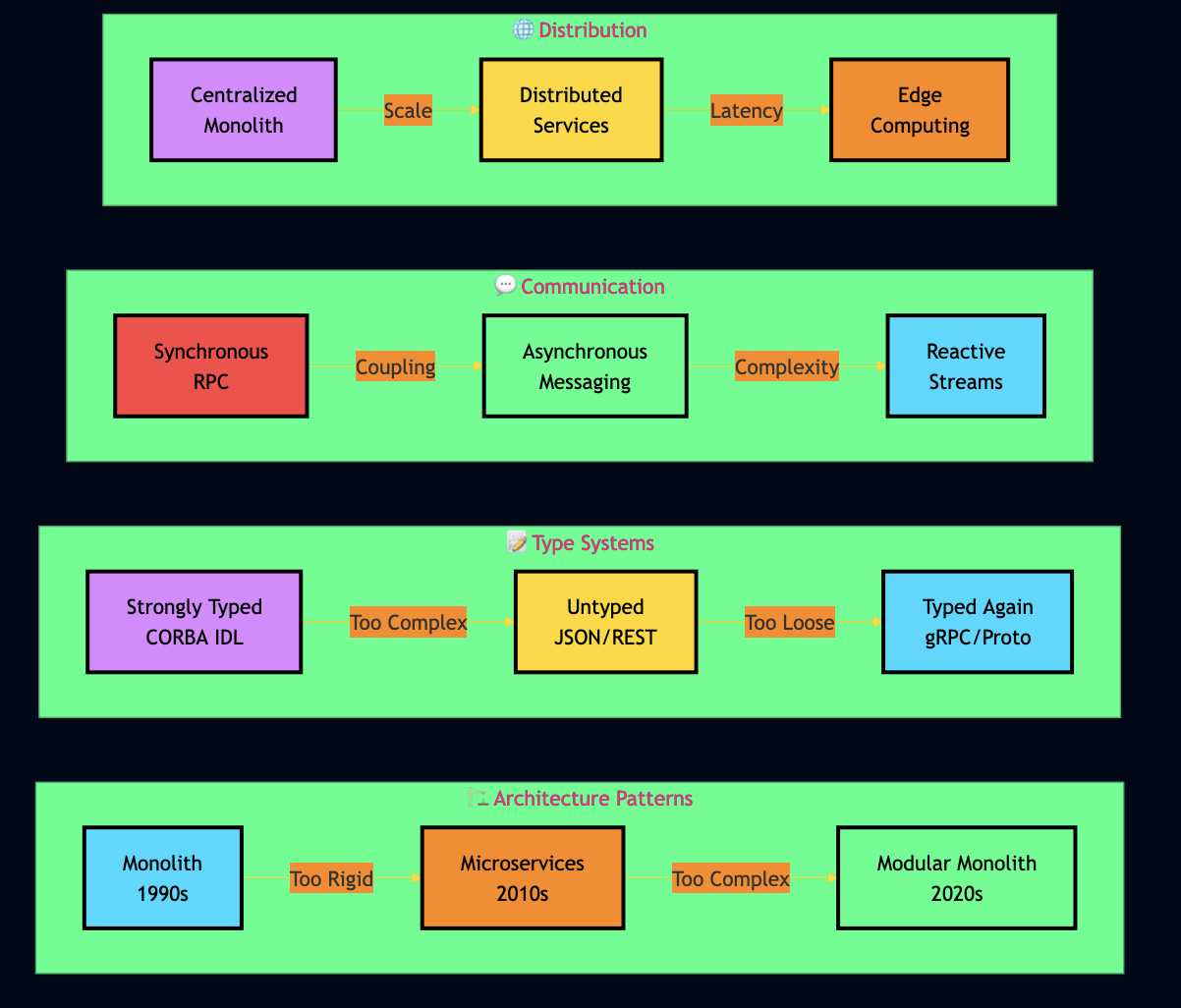
Each swing teaches us something. CORBA was too complex, but IDL-first design is valuable. REST was liberating, but binary protocols are more efficient. Microservices enable agility, but operational complexity explodes. The sweet spot is usually in the middle. Modular monoliths with clear boundaries. REST for external APIs, gRPC for internal communication. Some synchronous calls, some async messaging.
Here are a few trends that I see becoming prevalent:
- WebAssembly may replace containers for some workloads: Faster startup, better security with platforms like wasmCloud and Fermyon.
- Service meshes are becoming invisible: Currently they are too complex. Ambient mesh (no sidecars) and eBPF-based routing are gaining wider adoption.
- The Actor model will eat the world: Serverless functions are actors and durable functions are actor orchestration.
- Edge computing will force new patterns: We can’t rely on centralized state and may need CRDTs and eventual consistency.
- AI agents will need distributed coordination. Multi-agent systems = distributed systems and may need message passing between agents.
The best engineers don’t just learn the latest framework, they study the history, understand the trade-offs, and recognize when old ideas solve new problems. The future of distributed systems won’t be built by inventing entirely new paradigms instead it’ll be built by taking the best ideas from the past, learning from the failures, and applying them with better tools.
Check out my other blog posts:
- The Complete Guide to gRPC Load Balancing in Kubernetes and Istio
- Evolving Software Development Model for Building Distributed Systems
- Fault Tolerance in Microservices
- Effective Load Shedding and Throttling Strategies
- Property-Based and Generative Testing for Microservices
- Architecture Patterns for Sustainable Delivery Pipelines